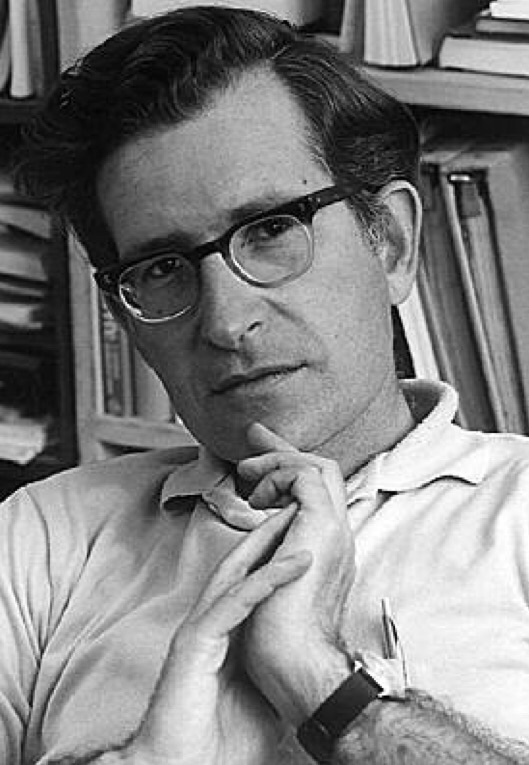
 Today, we continue honoring the ninetieth birthday of Noam Chomsky, turning to his extensive contributions to linguistics, cognitive science, and philosophy of mind.
Foucault
In 1971, Noam debated renowned French philosopher Michel Foucault, persisting the innateness hypothesis, or that the language faculty and some accompanying structure, are innate in all non-pathological human beings. Foucault, by contrast, defended the lingual empty vessel belief, requiring that no knowledge of language, or any kind for that matter, exists at birth. Among Chomsky’s arguments, of interest to my computer science readership, is that children can’t possibly learn the complexity of language by the very scant information gained from parents. The debate transcript appears on Noam’s personal website, and here is the complete video. It’s impossible to do this debate justice in just a few words, so I’d entreat you to read or listen, and prepare to be dazzled.
Day at Night
Chomsky appeared in 1974 on the short-lived public television program Day at Night, hosted by the late James Day, offering an interesting look at Noam’s interest in linguistics, activist roots, and the cognitive capacities of the beast called man.
“Grammar, Mind and Body – A Personal View”
Noam visited the University of Maryland in January 2012 to deliver an address to the Arts and Humanities Dean’s Lecture Series. This could be one of the most intriguing discussions I’ve found on his philosophy of mind; among the jewels revealed is Galileo’s lament that science had, and perhaps cannot, replicate even the most elementary of phenomena found in nature, and that his spiritual successor Newton demonstrated the impossibility in even proving the existence of the machine, to say nothing of exorcising its ghost.
Stony Brook Continuations : On the Philosophy of Mind
In what is chronologically the second of his Stony Brook discussions, Noam waxes the “philosophy of mind” with fellow linguist Peter Ludlow. Be prepared for a technical, and thus moderately inscrutable discussion. It nonetheless entertains.
Stony Brook : Evolution
In another Stony Brook discussion, Chomsky chats with Richard Larson about linguistics and evolution.
University of Washington’s Reflection
Upon Reflection was an interview program hosted by Al Page during his days at the University of Washington. Chomsky appeared in 1989 to discuss “The Concept of Language.” Among topics is the continuity by region, the variety of outcroppings, and the endangerment of rare forms, especially among near exterminated indigenous peoples.
Mind and Language in Boston, Narrowly Missing the Weather
Noam appeared at Boston College in the spring of 2011 to deliver yet another talk on mind and language, this time narrowly escaping the dramatic snowstorm in the winter of 2010 to 2011.
Jonnie Doebele and Linguistics for the Layperson
In 2011, German filmmaker Jonnie Doebele asks Chomsky to explain linguistics for the layperson. The ensuing discussion offers an amusing jumping-off point for the less technical curiosos.
Why Only Us
In 2017, Chomsky discussed joint work with collaborator Robert C. Berwick, professor of computer science and computational linguistics at MIT, on the origins of language; specifically, and I think correctly, they argue both from a computational and an archeological perspective that the language faculty appeared in humans as a mutation, and that its most apt characterization begins with the internal capacity to think about collections of objects, and ultimately the development of highly sophisticated internal models of the external world. More specifically, and counterintuitively, language didn’t develop as a means of communication.
Final Thoughts Today
Indeed, it is impossible to summarize the vast intellectual achievements of Noam Chomsky, despite the hours upon hours of the talks, interviews, and debates available online. We present only a paltry sample, and this excludes more than a tiny fraction of callouts to the myriad and many books, articles, and monographs featured in his and many other scientific disciplines moved by this great man.
Return tomorrow for one more day of honoring Noam, and for a special birthday present I prepared for his enjoyment.
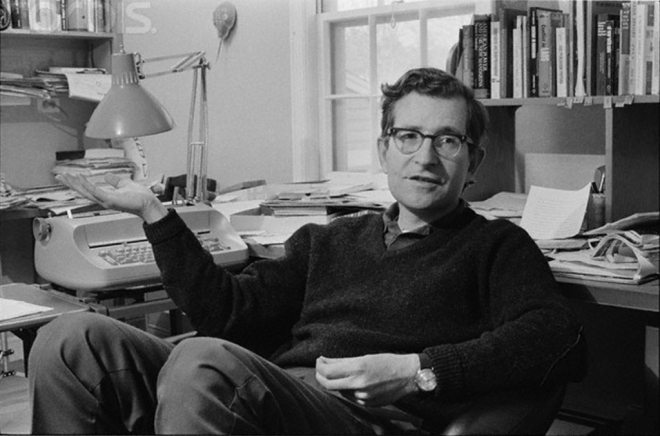 My friend Noam Chomsky, a man of unparalleled scholarship and without peer in his lending the power of the ivory tower to the powerless, celebrates his ninetieth birthday this Friday. Now, anyone reading this blog would easily understand the profound admiration I hold in my heart for the man who, more than any other, demonstrated to me that not only is making a difference possible, it is essential. Encyclopedic, direct, and unwavering, he powerfully critiques state power and structures of domination and control, arguing that legitimacy of such structures must meet a high burden of self-justification. He emphasizes also the twin existential crises of the day, catastrophic climate change and nuclear proliferation, pointing to alarming environmental indicators and historical near-misses of nuclear attacks and accidents. It’s my genuine belief that we’re truly blessed to have ninety years with a man whose origins and giftings coalesced into such principle, magnanimity, and accomplishment. And there are, indeed, many Chomskys. Computer scientists know Chomsky of the eponymous
  Scire Populum et Potentiam