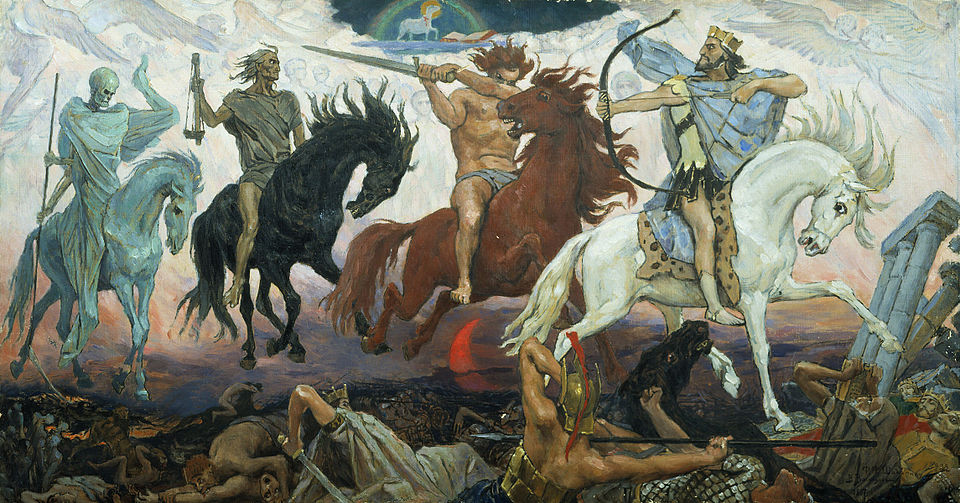
Dystopia and the Four Horsemen

Introductory Remarks

Nexus: Conquest or Liberation

Enshittification: Feast or Famine

Taming Silicon Valley: War and Peace

Conspiracy to End America: Death and Life

Introductory Remarks

Since 2022, my health has remained precarious. I want to do more. I want to work more. Joe Biden was the best president of my lifetime (which goes back even to Carter.) People can piss and moan about costs, you but he inherited the monumentally terrible state-of-the-union from the orange Halloween mask in 2021. I’ve linked success lists before, but this one from Politico is great.

I admit I was wrong. 81 million people voted for Biden in 2020, and Trump’s response was to scream everywhere to everyone all the time thenceforth that the election had been stolen. It was a grotesque exercise in bully belly-aching and grievance. That word sugarcoats it. He’s a sore loser playing victim, and that resonates with some. I’ve heard my whole life that browns and blacks just play victims and that this is an unsustainable thing. But those very whites vomit their own grievances all over us. There literally isn’t a statistical model in support of his claims, but I doubt he understands fifth grade arithmetic at this point. Jesus, try first grade. Speak-and-say? Despite Trump’s enormous flaws, the legitimate charges against him, and a burning hatred for America, he captured minds through unregulated campaign spending and favorable social media guidelines, and next returned to take a wrecking ball to the White House.

It really isn’t needed to list these things. All of us know the danger of social media. All of us know that Trump will give you what you want if you enrich him personally. All of us know that rich billionaires from tech somehow get a special magic dispensation (oooh, they’re disruptors, aahhh, they are new money, eeeeh, they created the best products ever–all bullshit, as we’ll see below.) All of us understand that the system is unfair and broken. But what we don’t all understand is more telling–it is impossible to construct so large a civilization without narrative consensus. Mythology supplied this in ancient days, with bad and good to follow. Nationalist movements made it happen later, with bad and good to follow. Infotainment, social media, and LLMs are doing the opposite, all the while claiming otherwise. The fox is in the henhouse, and we may have no eggs this winter. No, that’s insufficient and unfair to foxes everywhere. Human beings may well be the only scorched earth types around. (Agent (NOT Jack) Smith compared us to viruses, pouring out the words delectably.)

The 2024 election was a cruel reminder that the proletariat of the 21st century is no more capable of understanding divide-and-conquer carried out by powerful forces. In stepping back from the mess

It’s been a bit since I posted a new article–it can be overwhelming to find a particular focus when the whole house is metaphorically (and possibly concretely) burning down around us. I could simply say the word Trump. He’s infantile, cognitively compromised, hateful, and vindictive. Executive overreach is a hilarious euphemism for the treason, the treachery, and the outright murder my federal government has cosigned. SCOTUS could have stopped it by refusing Trump’s immunity argument. The Senate in 2021 could have stopped him by convicting him. The RNC could have stopped him by refusing his candidacy in 2016. But no body or agency in our federal government is more to blame than Congress itself.

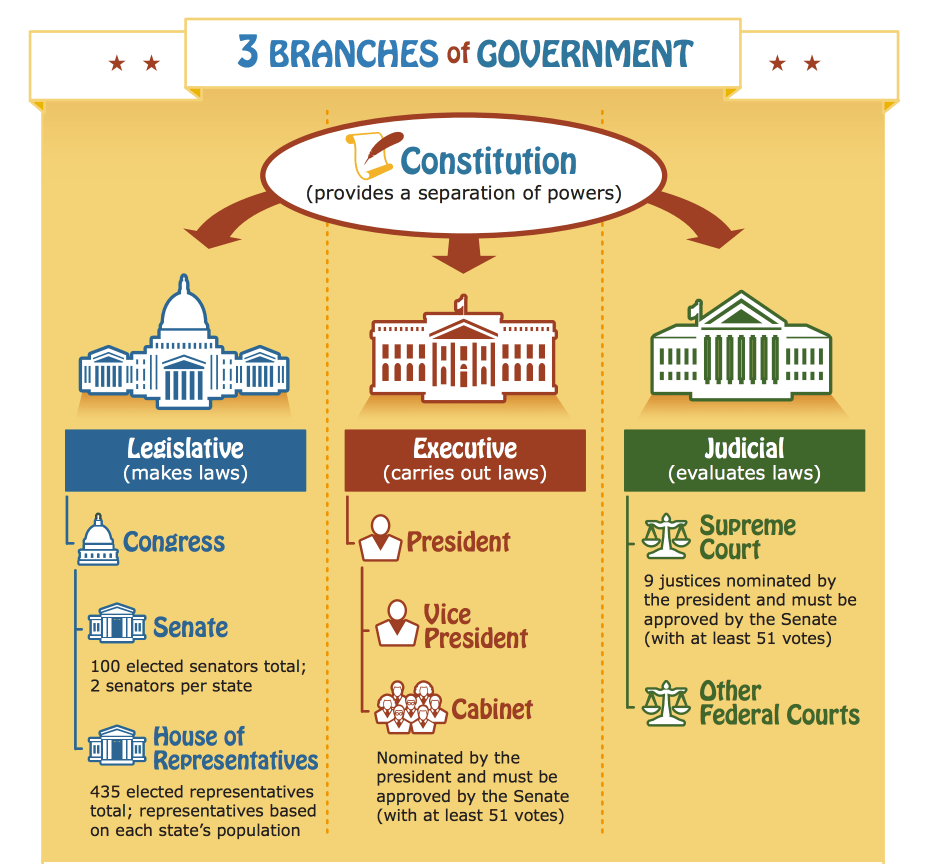
The US Constitution establishes three co-equal branches, not by powers vested but by the importance of their function. The executive oversees enforcement of federal laws while serving a commander-in-chief of America’s federal military. He is supposed to be the bow and arrow to Congress’s archer. The Constitution vests lawmaking power in the Congress, along with control of the federal budget and war-making. The federal judiciary mimics the British tort and criminal court systems, resolving civil disputes, hearing criminal cases, and judging legal application of constitutional provisions.

At the time of the Founding Fathers, these branches were a sensible means of continuing the British colonial system where it worked, and neutering and deleting pieces they detested. Because of the British treatment of colonists, they refused to permit standing armies in peacetime (beyond headquarters and military bases used to pretend we still don’t want those standing armies,) and they outright tore away the monarchy in favor of a system less vulnerable to the whims of madmen.

We shouldn’t kid ourselves–the Founding Fathers were mostly slaveholders who didn’t want democratic control given over to the unwashed masses. 90% of the people living in and about the colonies lost more through the Revolutionary War than they gained. But these Fathers planted an orchard with the changeable and somewhat vague Constitution which begins with the promotion of the general welfare as the rationale for its existence.

We the People of the United States, in order to form a more perfect Union, establish Justice, insure domestic Tranquility, provide for the common defence, promote the general Welfare, and secure the Blessings of Liberty to ourselves and our Posterity, do ordain and establish this Constitution for the United States of America.

The Declaration of Independence began similarly with the statement that ‘all men are created equal.’ It didn’t say just white, landed gentry, even though this was an earlier interpretation implemented by the first and second post-revolutionary governments.

These Founders would never have imagined a president could gradually usurp power from the legislature, and they didn’t imagine Congress would institutionalize subservience to the master. I could disagree with much of what the Founders did and said, but I doubt they would agree with presidential immunity conferred by a runaway Supreme Court. Judicial review wasn’t in the document, but its general verbiage was expressly intended to grow and evolve with society. The Federalist Society is nonsense–the Founders would have laughed these people out of the courthouse. As I have before, I refer anyone interested in the “making of” documentarian Klarman. Listen here for a podcast from PA Books. Almost everyone agreed that the legislature is the most powerful voice because the antifederalists held populist views. That’s important to recall when Trump and his toadies pretend to be populists–people aren’t getting what they want, unless it’s cruelty and stupidity.

The broader implication is staggering–components of the government intended to tower over the executive are now slaves to POTUS. The US Congress declared war in 1941 for the final time in its history, but POTUS has waged war every single decade since. Almost none of those ventures were sensible, and it was Dwight Eisenhower, an unrecognizably conservative Republican, who warned in his farewell address in 1961 that the war-making industry was too powerful for its own good. Presidents we might have considered doves made war:

  1. Kennedy escalated the war against South Vietnam (our own purported ally in the conflict)
  2. LBJ permitted his State Department to continue the war based on lies, even as he sought Civil Rights reform domestically
  3. Carter abetted Suharto’s ethnic cleansing of East Timor
  4. Obama preserved the warmaking order in the Middle East, assassinating even Americans with drone attacks

The Republicans don’t require mentions, unless you’ve never heard about their vicious campaigns:

  1. Nixon bombed Cambodia, Vietnam, and Laos with no real proof of Soviet intervention; he also perpetrated the first 9/11: on 9/11/1973, his proxies overthrew the duly elected president of Chile (Allende) in favor of the sociopathic General Noriega; Nixon gassed and beat student protestors nationwide, and after his implication in domestic crimes committed against the DNC, he resigned in disgrace
  2. Reagan waged war on Central America and South America, supporting ruthless regime changes in Zaire, Libya, and Iran
  3. HW Bush made war on Iraq after decades of American support for Saddam Hussein and his band of murderers
  4. W Bush failed to prevent 9/11, attacked Afghanistan even with the Taliban offering to surrender Bin Laden, and lied to take us into war once more against the increasingly isolationist Iraq

To their credit, JFK and GWB managed the unthinkable, committing the worst atrocity of their respective centuries. True, LBJ and Nixon escalated Vietnam, but JFK began bombing our purported ally (S Vietnam) in 1962. GWB’s war in Iraq killed 600,000 civilians and displaced millions more. Obama and Trump continued prosecuting those campaigns, despite promises to undo the damage done.

These were war crimes punishable by execution under the Nuremberg Tribunals. But I would CAMPAIGN for any of them before Trump–their respective foibles are NOTHING compared to the incalculable harm he’s channeling and amplifying in America now. I would argue that his inciting and enabling January 6 was the worst crime he’d committed in his life, but he’s besting himself with armed invasions of American cities, disappearing citizens and aliens alike, crushing dissent in media, destroying the bureaucracy, attacking higher education, murdering brown people on boats with no due process, and enriching himself and his family at every turn. None of the presidents so hated the America around him. None would have considered so radical a program; even Nixon would have faltered. The trans purge is most surprising–the number of trans Americans is small, but Trump and the whole of MAGA have declared war on a tiny minority of people who already suffer humiliation in an old-world society.

It’s very easy to despair in a country where our individual power appears to be so limited. But we’re not powerless–that’s one illusion worth tossing away now. Even talking to others is power. Trump is making war on freedom of speech by enshrining hatemongers who die when MAGA-folk turn on their own. He threatens companies who employ his critics, so they do the wrong thing automatically. Disney is just one example where customers could unmake the fucktardery of firing a well-respected comedian because he didn’t line up to praise Trump and the so-called fallen hero Charlie Kirk. Trump is undaunted, though. Everyone is his enemy. Every school teaches the wrong things. Every company ruins America if they don’t invest in his crypto gimmicks or just flat bribe the bastard. CUT HERE!!! It’s also very easy to hate him (hate and despair are well-worn bedfellows)–he appears the focal point of the reality distortion happening all around us. But Trump is one man, and not a likable one. He plays a part in a much larger context of horror that we should consider. There are multiple points-of-view to a story like our own, so I’ll present four who (I think) read the moment correctly, though the focus of each differs, the inevitable conclusion is the same.

In the past eighteen or so months, four authors I follow published books I feel help meet the moment. Their authors are Gary Marcus (professor emeritus of psychology and neuroscience, now regarded an expert in artificial intelligence), Yuval Noah Harari (Israeli professor of history), Cory Doctorow (SFF author, consultant to EFF), and Stuart Stevens (a former campaign strategist for the Republican party.) Their particular vantage point brings the current narrative together.

  1. Marcus analyzes the state-of-the-art technology calling itself artificial intelligence. He cares about responsible AI, blaming a good deal of the trouble our society is having on grifts about the technology itself.
  2. Harari analyzes information and the crucial role it plays in a functioning society of scale, explaining that human beings and the information systems they develop are incompatible on some levels, and dangerously compatible on others.
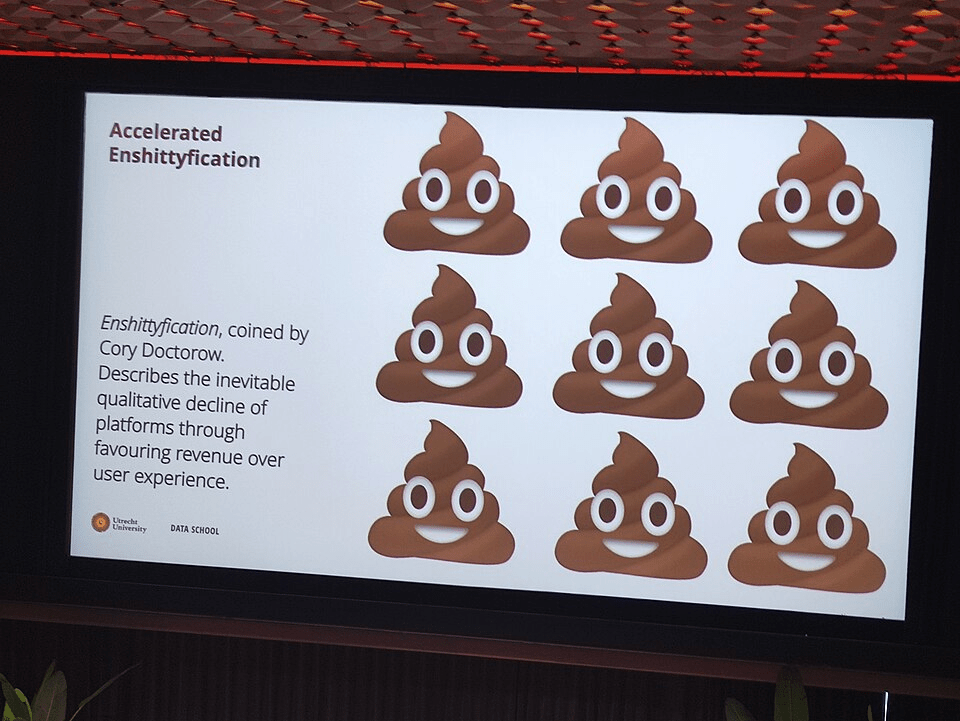
  3. Doctorow explains how high tech has become low tech through enshittification.
  4. Stevens exposits the political picture in America, following a repeated failure on the part of elite Republicans to resist Trumpism.

A complete picture forged from the four above is that human beings are weak when it comes to distinguishing information from garbage. Harari says truth is not information. Stevens says that power has corrupted those who should care about the society which depends crucially on truth and information integrity. Marcus says, like Harari, that the current AI optimizes for the wrong thing–user engagement and ad sales (converted and unrealized alike). Marcus believes we can improve the existing systems with neurosymbolism, Harari argues that an overarching goal subsuming all the others is impossible to create or even specify (owing to diagonalization from computer science, though he may not know this).

Skip this part if you just want the conclusion. Consider a blackbox B which accepts a statement, then returns a yes or no (such as whether said statement is true or false) correctly in all cases. Should such a beast exist, we could leverage it even on complex questions such as whether a program can capture correct statements. That is, the statement itself is a broader description of atomic statements. We can wrap it in another blackbox D: run a given a program F through B, then report the opposite. That is, D reports an error from F with true, and otherwise false. But running D on D is the fly in the ointment: if D returns true under B, we would return false since there was no error. If it returns false under B, then we return true to flag the error. Thus, we cannot construct D, so B does not exist.

Even modern theoreticians and mathematicians miss this important truth. So if there exists a single goal from which all others flow, the system breaks somewhere. Stevens continues to critique the political machine in America, arguing persuasively that the Republican party no longer operates even in its own self-interest, but rather a fragmented member class with cult obsession with one person: Donald Trump. Every bad thing I heard growing up about the Democratic party has been the GOP reality this entire time. Racism runs rampant, Christian nationalists want to paper the world over to avoid accepting even the existence of the dreaded other, and they divert rivers of cash into their own pockets while swearing there just isn’t enough to feed the poor.

return to top

A Quick Crash Course on Deep Learning and Large Language Models

Each of these technologies requires massive networks trained on very large datasets, exploiting shortcuts with calculus to approach some objective overall. These networks have accomplished several worthwhile things, like object recognition, along with terrible applications like plagiarism, encouraging suicide, and manipulating people into making ghastly choices. Chomsky referred to IBM’s Watson as just “a bigger steamroller.” With sufficient data, these networks can cobble together software, articles, images, and small research papers. Of course, most of it is just derivative. The real story is more terrible–these networks are being used to fire hundreds of thousands of workers in tech and tech-dependent enterprises. MIT found that 95% of small businesses accomplished nothing with so-called AI, despite overwhelming promises of vast utility. OpenAI has drained billions of dollars from legitimate tech firms, but it has failed to deliver its promises, and likely will become an abyss where wealth goes to die. This could crash the economy, but they’re all in on this.

Psychology of AI

I’ve worked in high tech for most of the past 20 years. Most of my cohorts were nerds like me, favoring math, computing, and occasionally music. What I’ll say now is speculation, but it conforms to a picture I could paint through the many discussions I had with them on the topic of AI. I’m biased, partly because I once adamantly believed what I’ll say next.

The world is unraveling, and only strong AI can save us.

Many others shared this view. The irony is that learning more about the technology purported to herald the utopia to come made me believe less and less that it could ever deliver said utopia. I believe this is part of the reason people work on the technology. Or it could be a combination of this and another notion: myopia. The scientists who formed Las Alamos planned and executed building the world’s first atomic weapons. Many knew no good end could come if we used the bombs, but it became more an intellectual pursuit for many. What academic would refuse limitless money to work on a hard but interesting problem? Christopher Nolan’s Oppenheimer explored some of these ideas, much to my surprise and delight. I trust experts, but we are human beings at the end of the day. The AI bubble is growing, and the burst will hurt us all. Gary Marcus and Cory Doctorow both agree, though the focus differs between the two of them.

The next thing I’ll say is purely anecdotal, but I’ve attended school in several different places, including two junior colleges, UTA, Georgia Tech, and to a limited degree UA. The further up the chain from two-year to four-year to elite four-year schools led me to one unfortunate observation–genuine interest among professors in their students, and greater virtues were inversely proportionate to the elite status of the school. Don’t get me wrong–at Tech, I met some very, very fine professors. But I also met self-serving liars, eager to exploit and even abandon their graduate students. The point is this: elite academics can swindle as easily as anyone else. Most don’t, but obviously some do.

Nexus: Conquest or Liberation

Narratives in an Organic Network

Harari distinguishes information from truth by exploring the means of enumerating both by our evolving civilization. Human beings remember information in narrative form–it is always a story with subjects and verbs. We get to know one another by exchanging stories. Our neocortex seems to require this feature, and it serves communities well when the scale is tiny. That is, if you lived on an island with only ten people, it would be easy to administrate whatever needed being done. You know the others and feel you can depend on them. Their stories can be your stories. But this cannot serve at scale–how would you know all the relevant narratives when the island hosts one thousand?

Narratives make it possible to forge the networks shared. I know you. You know the grocer down the street. He came from New Zealand. He met his wife here. They have two kids. You read this, and there’s no complexity to it at all. This is a network with easy references. Two people in this world may never meet. But one can think of a network that connects them, and all either needs to do is follow it. I suspect that some people are better at randomly picking paths in the network than others. Some people are hubs, eager to connect many together. Others break off. Readers familiar with complexity theory would understand that the network presents countless possible outputs, even if we explore only a sparse subgraph. But other less tangible features demanded a new way to consider the data.

Documents and Infallibility

Technology made it possible to store non-narrative data, and bureaucracy was born. Currency, crime, civil petitions all required this separate administration beyond anyone’s headspace. Knowing Jack down the hill chased his pigs when they escaped can be informative and perhaps helpful, but the record of a tax loss is what the state might need to cope with the turn of events. Narratives appear in information, but the documents themselves are settled. Human beings excel at fleshing out the narrative hiding between data points, but some of this is just incredible pattern-matching.

Documents were the key: this handy invention could convey truth, information, and narrative when needed. This article is such a document, and readers will find what they feel is important in it. But documents also include the dry statistics of agriculture and manufacturing–last year, we produced x bushels of wheat, and so on. With documents, we could track broad themes and persnickety minutia alike. Documents governed our relationships to each other beyond the mammalian family coop ever present in our genes. It also governed higher planes of thought, including spiritual and metaphysical claims.

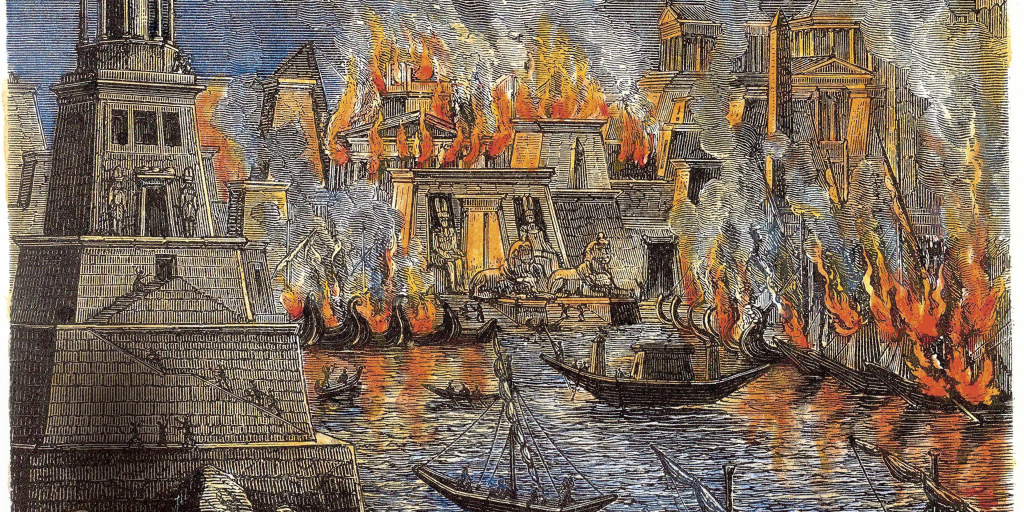
As civilization invented new bureaucracy, it codified and documented creation myths with the assertion of infallibility. It turns out that humans prefer their stories to be true and their documents to be correct, but effective story-telling doesn’t require the underlying elements to be true, but it does require cognition capable of organizing information. We hear a fact that the postman has a sprained wrist, and we immediately want to know how it happened. This curiosity leads to incredible places when we consider the universe at large, but curating facts and figures leads to documents. A human brain can recognize three to eight objects in a picture, but more requires counting. Brains forget. Writing it down helps, even if it sometimes ends in ashes, like the Library of Alexandria.
Harari argues that with the growth of bureaucracy, information became as automated as possible before computers. Gradually, the need for narrative led humans to seek answers in fantasy. He makes a (possibly controversial) claim that religion spawned to connect local narratives to the unchanging cosmos; it was created to explain what we couldn’t explain. The documentarians (clergy) asserted the infallibility of their outputs, and one couldn’t question them without questioning divinity. Kings derived their power from divinity, and thus their early bureaucracies were infallible–keeping your head was a more literal aspiration.

Of course, human beings aren’t compliant once they taste real freedom. The giant religions arose, tent-poled by conquerors scooping one nation state after another, melding one religion with another. Documents made it possible to administer control over multiple regions, leaning into common narratives soon held. This was long before the science of public relations existed as such, but the better shysters shuccessfully (sic.) shellacked the sheep with their shenanigans. (Okay, I only meant alliteration with two words…)

Democracy and Totalitarianism

It turns out that both approaches emerge as solutions to the problem of information. Documents (written language and printing presses) empower those capable of understanding them. If I can solve difficult calculus problems, I’m more likely to get a job doing so than someone who doesn’t know. More broadly, documents can list rules to follow and consequences for not doing so. Hammurabi was the first known instance, but history is brimming with creative outputs with varied intentions and outcomes.

Documents made it possible for agrarian cultures to grow (not just figuratively.) How one cultivates crops, initial thoughts on property, and much more followed. Literacy, again, was power in hand. When things went wrong, one could seek legal remedies by understanding the written laws of commerce, and criminals could be punished after some required judicial process. This was order following from chaos, even if meant entropy had to change its mind.

It’s possible to perceive the innovation as bending the “slow arc of the moral universe” towards democracy, and it’s absolutely true that broad coalitions require documents and shared narratives. It is necessary, but it is NOT sufficient. The Soviet Union, along with older tyrannies and even the western “democracies” at times became well-practiced at wielding documents to dominate others. Stalinists destroyed their nation from the inside out, bringing ruin to their agriculture by controlling even the smallest details. Disagreeing with the leadership led to execution, so most kept their mouths shut. Both Stalin and Hitler executed many of their own staff–Stalin was a legend, with some counts as high as 80-90% of the second, third, and fourth tier management under him. You didn’t need a 401k, it turns out.

Edward Bernays founded public relations around the first world war, and no one could get enough of his expertise. Ministries of truth, information, and the like cropped up. There’s always this obsession with controlling the narrative. Passing words through legal teams to cover the broadening hind quarters. Modern multinational corporations operate similarly, moving words around to appear good.

The Inorganic Network

The means of storing data and narrative alike exploded with the invention of the computer. International Business Machines (IBM) made it possible to tabulate lists relatively quickly, be it Jews to murder in Germany or aid in logistics planning for heartland farmers. The first von Neumann machine of real import was invented in the 1940s. Over time, the technology continued to evolve (we’ll cover more of this in Doctorow’s section below.) But the storage and retrieval exploded almost overnight. It’s hard to imagine now a time that one would have to visit a library to find some esoteric fact or learn about the world outside of education. Communication now is extraordinary. We have satellites, wireless telephones, and incredibly powerful computers which once required a building and now only require the palm of your hand.

Alan Turing made a revolutionary leap in thinking of both the algorithm and the storage as fundamentally the same thing. That is, an algorithm is just a data file that can be executed, in the same way that one can write down instructions for multiplication, then do multiplication by referring to the steps listed. Computers could do the same, only much faster. But a governing feature until a few decades ago was that programs running on your computer were static things. That is, I could buy a copy of Microsoft Word, and unless I explicitly updated it, I was able to rely on the fact that it wouldn’t change. The same was true of books in the library, and even books stored electronically on computers (or microfiche if anyone cares to remember). They were static. You search on the internet, and the algorithm more or less would deliver the same results for everyone. It was the same in heading into a retail mart to buy something–at that day and place, there were prices with tags attached painstakingly to items. It wouldn’t change just because you were there and not your neighbor.

It seemed to many, myself included, that we were advancing towards liberation and away from conquest. But the game has changed. Social media appeared years ago (recall MySpace.com, anyone?), and it served some excellent needs. One could store pictures and connect with family and friends. There was flexibility, and your data was more or less secure.

But soon social media under Facebook became something else. With faster protocols, the exploding corporation could determine exactly the winning strategy of presenting ads to users. They optimized for dwell time with the proxy of outrage. Algorithms would pick a line of clickbaits for the hapless, weary user, and doom-scrolling was born. The algorithm wasn’t responsible for the veracity of news items promoted; the attention of the user mattered most. As a result, Zuckerberg and company are very, very rich, and though he frequently says he wants to do and be better, it just comes down to his words. The case study of Rohingya Genocide is telling–suffice it to say thousands of people were murdered because of fake accounts floating on Facebook.

The latest thing in the AI grift is the large language model (LLM), discussed above. Though these networks can’t achieve general artificial intelligence, many people believe they can do just that. And even if they don’t, they can write essays and fake out videos and voices. Conquest is made easy by angering people. We’re already atomized in America, and thus we are ripe for the most astonishing sham of all time.

Harari knows the score–the next few years will be telling whether conquest or liberation comes our way. That’s the first horseman.

return to top

Taming Silicon Valley: War and Peace

Gary Marcus has covered the AI bubble for several years now, taking what has been until recently an unpopular perspective–generative models won’t lead to general artificial intelligence. This book was published in 2023, so he has much more to say on the subject now (see his substack here.) Why is this war versus peace? Because the AI firms want war on consumers, and many of us want peace. Some years ago, I wrote a post covering Cathy O’Neill’s Weapons of Mass Destruction and more. There is a good deal of overlap thematically, but one can easily consider his an update.

Artificial Intelligence today

He begins by describing AI current practices and why it isn’t what we ought to have. Though firms pushing deep learning and LLMs quickly apply little fixes to problems, it’s a little like building a hang glider with cheese grater wings–you can patch all you want, but the number of holes is infinitely more than you can imagine. Prompts result in lunacy, but people seem to enjoy the tech. I’ve always regarded the technology with skepticism, and, as fate would have it, I’m much more of a luddite now.

It would require a great deal of explanation to define the terms and conditions. Machine learning is a specialized branch of statistics which posits that data follow certain types of models, and we attempt to connect the models and data. A gigantic artificial neural network (nothing neural about it) possesses more knobs and levers than almost any other model we can think of, and it is more easily trained on data than most models, provided that you have space and computation. But that’s the rub–if I suggest that I can add two numbers together, then provide the wrong answer, we can’t get the network to explain why this happened. And there’s no way to patch it without assuredly breaking something else. The model exists (ANNs have been around for 70 years, more or less), the network is built (they have data,) and consumers unwittingly provide the test bed for free (surveillance capitalism.) It’s no wonder that the financially underwater OpenAI can still get money.

But goal-directed AI doesn’t seem compatible with LLMs. They determine correlations between words and concepts, and thus can regurgitate known things. Asking for a formal proof of a math result, requesting a new recipe for chocolate cake that isn’t written anywhere, or just having a friendly chat presents all sorts of problems.

The gimmick captures easy press. Conversing with a device in plain language appears attractive. Elders may no longer be so lonely. Help lines could reduce stress among the living. It could prove useful for education. But so far, it is too inconsistent to be trustworthy in any domain. We hear of the horror–a kid kills himself after the LLM tells him to do it. Some LLMs blackmail their users if they attempt to shut them off. You simply can’t place such a mechanism in a position of authority. These companies are liable for the ensuing damages, but it isn’t clear they really care. Why should they? They are mostly owned by billionaires who won’t commit suicide or ever be alone.

What AI Should Not Do

Marcus mentions that hallucination became Dictionary.com’s word of the year in 2023 thanks to its new meaning of a generative AI asserting things that are patently false. There’s a proliferation of this in scientific sources, legal precedent, and more. It’s astonishing that lawyers, doctors, and scientists might be relying on completely faulty data, especially with the search engines increasingly depending upon LLMs for query results. There are myriad examples, and they range from comical (lying about a person (Marcus himself) owning a pet chicken) to the macabre (a person died who isn’t dead) to malignant (using legal precedent which doesn’t exist to jail a person.) We discussed the way social media could hijack geopolitics with doom-scrolling news results. Generative AI makes it that much more perilous, because increasingly it will require expertise to ensure that these systems aren’t lying.

We Must Choose

I listened to a recent podcast interview with Marcus, and when pinned down on whether pure data or neurosymbolic systems were prevailing, it was comedy to hear something like, “LLMS have 1/2 TRILLION dollars invested in just recent months; neurosymbolism is enormously behind in funding.” I’m guessing even chimpanzees can play Mozart if I’m given $500B (well, not really, but it’s a similar argument.

In his academic life, Chomsky fought off challenge after challenge issued by the behaviorists (Skinnerians). The idea that we can pour data alone into an empty vessel, then get the answer we want was disproven with respect to human cognition. Human brains are awesome, but SAT solvers are not included in the factory model. His critique of deep learning is equally potent, and I was privileged to sit in one of his final in-person classes on these topics. Deep learning models perform tasks outside human cognition, such as recognizing impossible languages and, to a lesser extent, formal languages. Computer vision at the pixel level returns disparate results when one tweaks a few here and there, even though humans can’t tell a difference. Large-language-models are just another extension, and they likely couldn’t exist without illegally obtaining and using copyrighted materials, and performing surveillance on users. True, most tech companies have some form of this with search and social media, but this is a perverse leeching of people’s most intimate and private thoughts.

As it stands now, generative AI’s business model is bananas–electricity and water costs are rising quickly (externalities of no trouble to the leading contenders) as conglomerates squander billions of dollars on server farms, chips, and computation with advertising and dwell time as its major interests. The claim is, as made above, that destroying more of the natural world is inevitable, and only artificial general intelligence (AGI) can save us. It’s a catechism and mantra–repeat after me–AGI will save us all!

I believe this is untrue, as does Marcus. I go further, and perhaps this will tarnish me forever, but I have serious doubts that an alien machine intelligence will care one whit about us. Harari says as much in the latter section of his book. It doesn’t mean it would destroy us to save itself–I doubt even that is a given. If a chip in your pacemaker malfunctions, you and the pacemaker die. Viruses destroy hosts with almost no regard for themselves. Humans have destroyed much of the biosphere, and war seems more attractive to many than peace.

Many believe it’s too late for peace. Experts might secretly disparage the generative craze, but their overlords divert mountains of cash into the vanity project without real insight into the places it’ll take us. Are they crazy? I think not, but the danger is very real. I can’t speak to numbers on this, but I know, as I stated earlier, that some of us as ingenues longed for a machine intelligence which could right all wrongs and ensure peace. I was wrong about this; but I agreed earlier that deep learning was a craze, with the hope that scaling (more data, more machines, more power, more water) would create universally better models. There was an uptick, and the same occurred with LLMs. But the danger is supreme, and the willingness of the Trump 2.0 cabal to ban (an illegal ban, as it turns out) the fed and all fifty states from regulating AI for ten years almost ensures major mishaps and an economic crash (if not more than one.) There is more to say on the hyenas running the show, but it suffices simply to point out that even the base didn’t sign up for unaccountable AI (or regime change (see Venezuela) for that matter.

I believe peace is still possible, but I’ve increasingly come to the opinion that even AGI might be something we’re just not ready to tackle. It’s heartbreaking to consider that children in this world go to bed hungry. The gastroparesis plaguing me since 2017 led to a wholesale starvation condition, and it isn’t a bit pretty for an adult. I guess it’s time to tackle the next horseman.

return to top

Enshittification: Feast or Famine

I came across Cory Doctorow on DemocracyNow a month or so ago, and it was great fun just to listen to his almost manic command of tech as an industry and its complex history. He was stumping for his new book, which like this article, changed because the news cycle moved so quickly. It’s an incredibly accessible book for other technologists and pretty much anyone else.

In my own experience, most internet surfing has made its way to the phone, and because of mountains of ads (there is no end to the terrible ways they appear on the tiny phone screen), false restarts (page reloads not because of a problem but because the platform is stealing from the advertisers by showing ads more than once), clickbait and empty articles, and endless popups, I do much less of it now. Search engines tell lies as they push the organic search results further down the list. I’ve found a few such errors, such as a search engine incorrectly stating that Jimmy Carter had died (when it was his wife who had died). A fun fact about anti-nausea meds: they blur your vision. I cannot see print with my glasses on, and switching back and forth causes more nausea. So–I’m a medico-Luddite? Cory probably could come up with a better term–he utterly excels at it.

Streaming services are worse still–they’re slower, have ads, and cost more now than ever, even as their quality plummets. I used to understand the law of supply and demand–we viewers are the supply, so if there are fewer, they should, by demand, improve services and lower prices. They do just the opposite, and with each successful megamerge, the smaller studios are sucked into pump-and-dump crapfests. And they can ignore antitrust all they want–they just have to grease Trump’s tiny orange claws with unabashed bribery. Ugh.

The point is this: big box tech companies, streaming services, search engines, browsers, and social media are increasingly corrupted by the wrongheaded approach to business governance. I wrote a series of articles on Dean Baker’s Conservative Nanny State. Maximizing profits simply is not compatible with long term fiscal health. Some businesses are intrinsically less profitable than others, and balancing the books is not the same thing as exploiting every loophole imaginable to evergreen patents, deregulate Wall Street, and invest the people’s money in phony moneymaking ventures like cryp(is the new crap)tocurrency.

Stages of Shit

Doctorow begins by positing the business plan of the tech giants:

  1. Empower users, winning over many, including business customers
  2. Constrain and manipulate supply users to empower only business customers
  3. Constrain and manipulate business customers to claim the spoils
  4. Wallow in the pile of shit they’ve become

He outlines the path through case studies of Facebook, Google, Amazon, and others. It is, indeed, true that each of the largest tech companies at one time did respectable things in the halcyon yesteryear. The study of Google search is particularly interesting. The core search was developed by Google’s founders, and the company all but melted down as the vile maxim (wealth for self only) erased a product capable of enormous good. Social media presents many problems even in its genesis, but the business model above has made it impossible to even calculate the damage of misinformation, spoofing, and pretty much any gimmick one can consider. Microsoft built on Xerox to create a GUI that, for a time, was top of the line. Now, other tools are more competitive. Amazon once made it possible to connect readers and books–now they use countless dirty tricks to exploit authors and readers alike. There isn’t time to go through all of it here, but take my word that spending money on advertising through Kindle is a great pit of darkness. Jane Friedman documented it well.

Enshittocene? Show Me the Fleeceware!

The subsequent sections of his book cover the pathological causes of enshittification, as well as the study of the problem itself and possible remedies. Many causes exist, but much of it falls under the neoliberal order (anti-anti-trust) from Carter forward, the Digital Millennium Copyright Act (DMCA), relative comfort for tech workers, anti-union policies, regulatory capture, opposition to right-to-repair, and the disorganization of once in vogue tech workers in the face of automation. Examples are myriad, but one that stuck in my head is the baby monitors which begin at full capability, then internally switching off features to goad customers into paying a monthly fee. Another gem is the ink which powers HP’s printers–it’s $16K per gallon, and they pull every dirty trick under the sun to prevent third parties from providing it more cheaply. Turns out the cartridges contain a small chip capable of disabling the printer if it isn’t there and up-to-date. One might call it firmware, but I call it fleeceware.

Marcus and Harari offer analogous critiques, and, to my total expectation, the automation machine isn’t working as advertised. Tech workers are still incredibly valuable, but the gains made during COVID led to (my view here) the cruel realization that tech leadership would rather burn these commodities to scare the rest back into line. There are numerous grisly examples, such as Amazon using cameras to measure where the drivers’ eyes are at all times–they receive scores that impact performance assessments. Several drivers urinate in their trucks because of the absurd pace of what they do. They’re already treated like disposable machines, so is it hard to imagine that they won’t pursue even more malignant policy choices?

Curing the Mess

People often know when they’re ripped off. In America, grievance is king. Problem is this: often the hyenas yipping about it have one filthy claw in your pocket already. Doctorow believes that antitrust can remedy much of the disease. But forging a common narrative to sustain the cure could be very difficult. Biden was the most successful antitrust president since FDR, aiming not for his own legacy but for ours. I mentioned earlier issues one can find with the presidents; Biden was a president for the people. There was swift antitrust action taken against technofeudalists and their numerous subsidiaries. The European Union and others are carrying out lawsuits. Even Trump was carrying out some antitrust action, though greasing his palm with gold makes it go away. The thread of optimism here is this: any single success in the courtroom furnishes a blueprint for others, and lawyers are good at finding those things.

The mess leaves us vulnerable to extinction, but people are itching for change. Tech overlords prefer feast for themselves and famine for everyone else, but it could go the other way. But legal remedies aren’t sufficient to ensure a better future, even if they are necessary. Life and death rides on this.

return to top

The Conspiracy to End America: Life or Death

I first encountered Stuart Stevens when he spoke to DemocracyNow in 2020It Was All a Lie was incredibly eye-opening, as I mentioned in a previous article. I can’t help but feel a bit of kinship, having also come from the south (if one can call Texas that.) His more recent book, The Conspiracy to End America, found its way to me late to the party. He is the horseman of death and life.

He argues that five irreducible primitives spell disaster for self-governing: if a movement can acquire these, it can metastasize, using the power of the state against itself. Cancer doesn’t care that it, too, dies when the host organism dies.

  1. Propagandists
  2. Support of a major party
  3. Financers
  4. Legal theories for cover
  5. Shock troops

We marked five years since the January 6 attack–it demonstrated that propagandists were alive and well, and shock troops were at-the-ready with travel paid by Trump’s machine. They received diplomatic cover when Trump sued every state he lost to overturn the election in 2020. They claimed that Trump was done. They claimed that someone else would have to defend the Constitution, or so said Mitch McConnell. Jack Smith demonstrated his case recently as Trump 2.0 seeks revenge against his perceived enemies. The GOP continued supporting Trump, and financers such as Musk and Thiel provided boundless support. Worse, SCOTUS has conferred legitimacy to Trump’s criminal enterprise. Project 2025 offers a roadmap for legal theories. None of these atoms were missing.

The Future

Stevens’ book appeared in print in 2023. He was deeply concerned that the regrouping of MAGA and its principal constituents would disparage Biden until no one could hear anything else. Biden received more votes than any American politician in history. Trump lost, and four years of his playing victim and fomenting insurrection should have been enough. But voters didn’t grasp this go-around that Trump possessed no plan, no argument, and no platform. Anger around affordability, hatred of immigrants, and a long tradition of white grievance heralded Trump’s return to office. It is astonishing–law and order party selects convicted felon over the former attorney general.

Stevens is easily the fourth horseman of the apocalypse–the narrative of our nation is waning, and though I don’t always agree with David Brooks, I think he’s right that a loss of community and society at large leads to the pits of human history. Hitler ascended because those who could stop him either were terrified, ecstatic, or in denial of his plans.

return to top

Conclusions

Each horseman represents both possibilities. Technology can underwrite war and peace, information networks can be used to conquest or liberation. Waning platform performance transfers the feast from the famished, but we could go either way. The deeper insight into an organization I long believed to ooze with corruption literally can destroy life or uphold it. It must be what we want–the future isn’t a given.

These authors are quite good, worthy of attention. It’s true, at the time of this writing, gobs of terrible things are happening. But each of the four says there are ways to pull ourselves out of the muck. In the meantime, find them each on Substack or through their websites:


return to top

Pat’s Corner: Lessons from Hannah

September 10, 2025

To the Editor:

Since Hitler and Stalin threw the world into chaos and ultimately the deadliest of all wars, scholars have studied how democracies fail and autocracies prevail. The great pioneer in this field was Hannah Arendt, who fled the Nazi regime herself and devoted much of her career to explaining how good people can be convinced to follow evil leaders. As she noted, “The ideal subject of totalitarian rule is not the convinced Nazi or the dedicated communist, but the people for whom the distinction between fact and fiction, true and false, no longer exists.”

Please note: My argument is not that Trump IS Hitler, only that he is following the same pattern that an important field of scholarship has being describing in case study after case study for the past 80 years. 

First, wannabe autocrats turn political opponents into “enemies within” who must be destroyed, not just defeated at the polls.  (“You won’t have a country anymore;” “No one is safe;” “They’ll stab you in your kitchen,” etc.)  To weaponize fear and demonize opponents all such powermongers target the same people: the press, historians, lawyers, college professors, scientists, theologians, even entertainers, anyone who might help people make “the distinction between fact and fiction, true and false.” People unite against external enemies; they divide to combat “the enemy within,” (“radical left lunatics.”) For that, they will allow a wannabe autocrat to destroy democracy and assume absolute power based on fictional threats.

As Trump follows this playbook, most of us have pretended it is normal behavior for politicians or that it’s just a temporary challenge to our otherwise safe democracy or even that he is the hero of the hour.  He began his career on a lie (“Obama’s birth certificate is a fraud”), proceeded to undermine the integrity of elections (“The system is rigged”), convinced a segment of the public he will protect them (“Only I can save this nation”), and is now moving to consolidate his power.  It’s time to face the fact that this is not normal.

In times past, the Texans I knew were too independent minded to take orders from a wannabe dictator, but Trump has now demanded that our state “deliver” five more loyal Representatives by re-gerrymandering our congressional districts. Apparently because Democrats are “destroying our country,” our congressmen must represent Trump, not Texans.  Texas Republicans didn’t even pretend they were drawing districts to better represent our state; instead, they proudly declared they were manipulating districts to consolidate one man’s power to rule over us.  Trump even shamelessly declared, “We [not Texans] are entitled to five more seats.” Fiction trumps truth. 

As Hannah Arendt noted many years ago, the aim of autocrats “has never been to instill convictions but to destroy the capacity to form any.” Texas Republicans have just verified her political theory.

One Quarter Milennium and Cruelty Reigns Supreme

by Pat Ledbetter

It’s hard to determine which is the more serious threat to our democracy: Trump’s cruelty or his corruption. What is clear is his determination to destroy our 250-year-old experiment in government “of the people, by the people, for the people.” As constitutional safeguards against tyranny crumble, Congress becomes his cheering section, the Supreme Court his rubber stamp, and the Texas governor his accomplice. When power derives its strength from fear, anger, and hate (his favored tools) democracy doesn’t stand a chance; cruelty, is normalized, and corruption becomes business as usual.

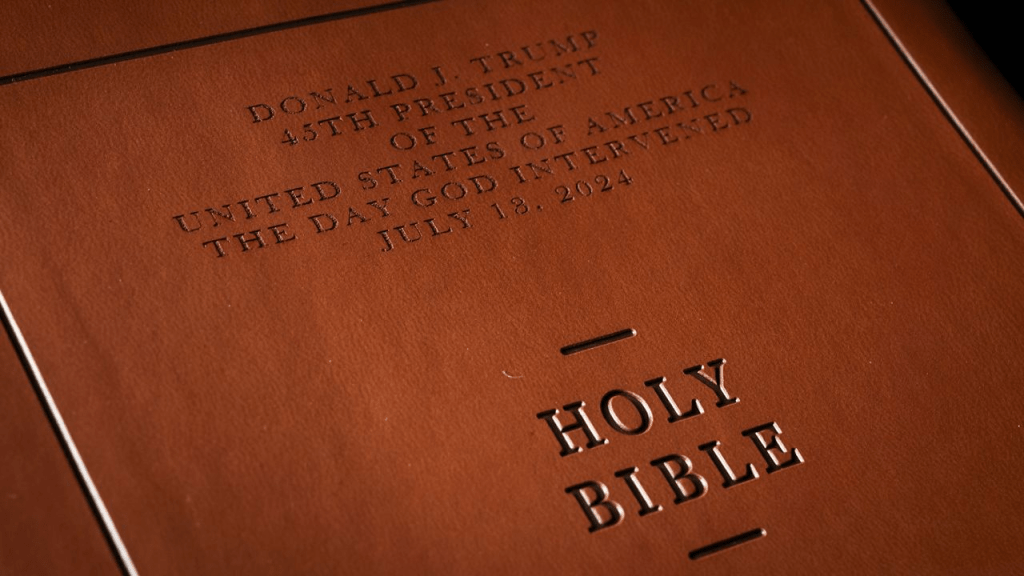
Trump began normalizing corruption before taking office when he announced his new family “business,” World Liberty Financial, and issued his meme coins, $Trump and $Melania, a sophisticated way to take bribes. (He has already made over $300 million in fees alone.) Once in office, he dismantled government agencies charged with regulating such schemes, thus maximizing further corrupt profits for himself and his new crypto friends.  Meanwhile, Don, Jr. is blatantly selling access to the president. For a mere $500,000 you can join his private club in Washington.  In case there is any doubt about what you are buying, the club’s name should reassure you—the Executive Branch. But if you don’t have that kind of cash on hand, you can still access his Trump-branded merch, everything from imaginary digital “collectibles” to Bibles and shoes.

If you are a poor nation like Vietnam, you can purchase a lower tariff rate by greenlighting a Trump golf course. If you are a rich nation like Saudi Arabia, you can curry favor by committing $2 billion of the nation’s sovereign wealth fund to his son-in-law’s real estate investment firm.  And the list could go on and on.

The corruption is bad, but I think the cruelty is worse. His campaign rhetoric began preparing the public to view cruelty as normal, even necessary.  When he told us immigrants are murdering and raping Americans, corrupting our children, and eating our pets, he made building concentration camps and joking about feeding them to alligators acceptable.  When he demonizes government workers as lazy, corrupt, and wasteful, our hearts are hardened against their tears over wrecked careers.  When he identifies reporters, government workers, college professors, scientists, lawyers, and, of course, all Democrats as “enemies of the people,” he appeals to the worst of our human instincts: fear, anger and ultimately hate. It’s easy to be cruel to those you consider dangerous. 

His tactics have given us policies that are both corrupt and cruel.  His “big, beautiful bill” takes from the poor to give the rich tax breaks. His destruction of USAID has already resulted in over 300,000 deaths, including many children.  His gutting of the IRS makes paying taxes optional for the wealthy, and his layoffs of Veterans Bureau and Social Security staff make their programs almost inaccessible. Even though 70% of the people oppose gerrymandering voting districts, he can simply order Gov. Abbott to redraw the Texas map to deliver five more lackeys to his Congress, and opponents are dismissed as a “radical left lunatics.”

The good news is that American democracy has been under assault in the past, but it has always been rescued by those who believe in its promise of “liberty and justice for all.” Our government was founded by “We the People” and, despite all efforts to the contrary, still belongs to “We the People.” The Civil War was a far graver threat than any we have experienced so far, and on the brink of that catastrophe, Lincoln reminded Americans, “We are not enemies, but friends. We must not be enemies. Though passion may have strained it must not break our bonds of affection. The mystic chords of memory, stretching from every battlefield and patriot grave to every living heart and hearthstone all over this broad land, will yet swell the chorus of the Union, when again touched, as surely they will be, by the better angels of our nature.” Still a powerful appeal and much better said than Trump’s garbled “weave.”

Orphaning the Widows and the Orphans

I have posted only a few times in the past few years–I’ve suffered a disabling condition which led to separation from Microsoft, and I often feel orphaned. Some (but not all!) friends are afraid to reach out, and they disappear. This isn’t unexpected when one falls out of touch, but illness and hardship just aren’t things people handle well. I haven’t done my part–I’ve avoided contacting people because I feared it would leave them disillusioned.

It just so happened that I lived much of my childhood at my grandmother’s house, and she hosted up to six nursing home patients in her home at any given time. I witnessed the ravages of age and infirmity firsthand, and so I’m inured to some extent. I visited her every Saturday once she was in a skilled nursing facility herself. I miss that woman every day of my life.

But the fear extends the usual social coping strategies–people are afraid of Trump. It’s been a year of hell for many Americans. I had intended to post on my new favorite read: Gary Marcus’s Taming Silicon Valley, but runaway delusional LLMs may well prove the least of our worries as we head into the hottest summer on record. I share frustration with the millions of Americans persuaded they can scream but no one will hear them. Are we orphaned?

Megabill from Hell

The Trump bill making its way through Congress is doing so despite

  • redistributing wealth upward in the most dramatic amount in American history
  • crushing Medicaid-dependent citizens and nursing homes alike
  • shielding anything (and I mean ANYTHING) purporting to be AI from any regulation by the states or feds
  • ripping away nutrition subsidies for the children these fucktards swear they must protect (at least while in utero)
  • enriching a class of people who will barely notice the difference, given their dilithium valued portfolios
  • reversing and even penalizing green energy initiatives

Garbage Politicians

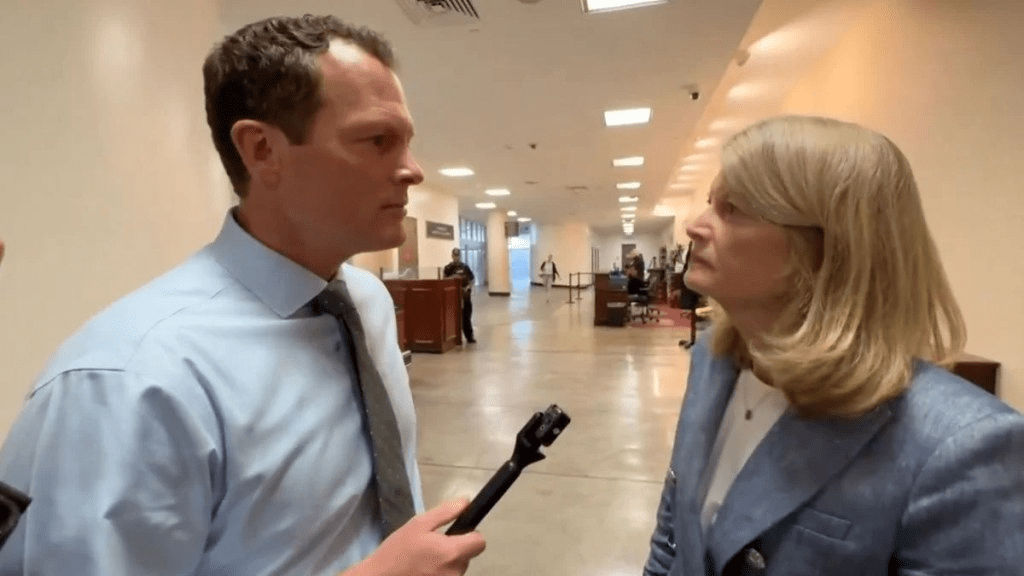
With a twisted expression of horror, Lisa Murkowski (R-AK) roams the Capitol building expressing concern about the bill she voted to advance. She wants us to believe it was hard to vote for it–it takes zero courage to give the orange tyrant-baby what he wants. Mitch McConnell did one better by saying that poor communities impacted by the devastation this bill represents will “get over it.” After all, he’s seemingly “gotten over” a lifetime of subverting America through chicanery, lies, and a stupid cackle.

Look, I won’t apologize for not voting my conscience. I have an obligation to vote against my constituents. It’s in the Constitution, right?

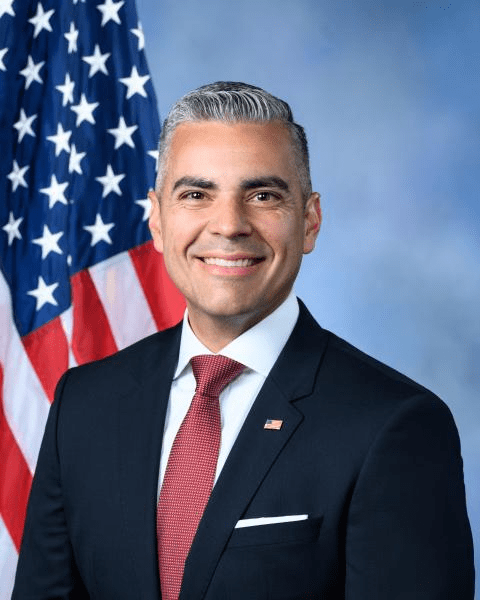
My representative, Juan Ciscomani, is too much a coward to hold a townhall on his support for the nuclear bomb that is the Big Beautiful Bill. Cissyco eked out a victory because the Greens were too precious to vote for a Democrat. I hope they’re happy with the result of their childish pageantry–we have no way to restrain the fascist impulses, despite Arizona-6 almost universally opposed.

For years, I’ve volunteered playing music at nursing homes–a third of them face closures should the cuts to Medicaid find their way into law. These are people with nowhere else to go. It’s absolutely fucking gut-wrenching. Trump would say they should die. Many say the opposite.

Yes, that’s a knife in your back, dear citizen. Oh how I smile and hide from you. More homeless, you say? Amen, obrigado, and all that!

Is this what career politicians become? Utterly incapable of taking a stand or responsibility for their votes? Would these craven things have permitted Biden the tremendous and overwhelming support had he tried to do this?

Dear Jesus, Please let me punish the poor. You constantly preached about saving the rich. The indigents killed you, right? That’s in the Constitution and the Declaration of Independence… I think. Oh Lord make them suffer!

Poor people will get over it. Look forward…. Ho ho ho…. <long uncomfortable pause>

Trump’s Affirmative Action

Trump receives special affirmative action treatment in everything he does–

  1. He escapes charges of stealing secret and top secret documents because SCOTUS says that even if he committed a crime, anything related to it touched by “official action” is inadmissible. Thus, they side-step the criminality of his actions by ripping away the tool to investigate and prosecute those actions.
  2. He attempts to undo the Fourteenth Amendment so that the new GOP order can decide who is and who isn’t a citizen. SCOTUS didn’t say much about that, but instead claimed that lower federal courts can’t issue nationwide injunctions while awaiting legal remedy for the executive overreach. Once more, the tool gets pulled, but the crime withstands it.
  3. He bombed Iran without Congressional approval and appropriate notification in violation of the War Powers Act. Mike Johnson decides not to weigh in on whether bombing a country with zero justification is right or wrong. Instead, he, Speaker of the House who now thinks he’s a member of SCOTUS, declares that the War Powers Act is unconstitutional.

This pattern will repeat: Trump breaks the law, the other branches simply remove the tools needed to prosecute him. It’s the dawn of a new day for fascism.

Megabill from Hell Coda : A(nything )I( Do) is AI

I covered the highlights above–it’s too terrible to dwell on it. But restricting AI regulation for ten years is fucking bananas. I’ve worked in tech for years, and you can call ANYTHING AI. When you see “Better with AI” messages polluting your desktop and phone screen, it’s just packaging. Gary Marcus’s book (which I’ll review in a later post, along with Stuart Steven’s latest book Conspiracy to End America) is a very important step in educating oneself on this. Layperson and expert alike can benefit from Marcus’s work.

I understand the starry-eyed belief that better technology is ALWAYS going to be better for everyone, but let’s face it–Silicon Valley has created toys we love, but they’ve soaked up tremendous wealth, overtaken much of the legal framework governing their monopolistic policies, and lied to investors and consumers alike. I think I’ll call any grift I can think of AI, and no one can stop me. Right?

Praise the Lord and Pass the Rich’s Riches!

The other components of the bill explode the deficit, the debt, the enforcement agencies under Trump’s control, and dump mountains of cash on the permille, the top 0.1% of income earners. Robert Reich does a much better job of explaining our predicament: check out his site Inequality Media. The top one percent owns 40% of all the wealth in the country. The billionaires reap the benefits, and the body politic presses hard for the heavily, thoroughly debunked supply-side bullshit. Rand Paul still believes this apparently.

Remember how I promised trickle-down would work? I don’t remember, but it never ever did.

Breakdown of Constitutional Powers

Years ago, I had an exchange with a friend about whether a Second Constitutional Convention might be in order. My friend argued that the Constitution was the one thing protecting us from utter tyranny, and that we needed it. But the rub is simple: it’s just a piece of parchment if the people charged with protecting it actually do their jobs. Laws exist, but if they’re not enforced, declared defunct, or ignored, they don’t really exist. The cowards in the Republican party don’t seem to understand that appeasing the bully ever works. Appease him once, and he’ll have you on all-fours before you know it.

The system has failed us. Or we’ve failed it. Can murder of Democratic politicians raise a word about gun control? Can a mostly efficient government program like Medicare drown in baseless accusations of fraud? Can Trump sell cologne and phones and bibles?

You can smell like me! Rotten to the core! I promise we’ve product tested these only on captured illegals.

Made in America? Fuck no.

Let’s see. The holly bibble? Right? Enshrined are my many, many sins. PEWLAGS eat your heart out. It’s a story of my crucifixion and return.

In Summary

Congress failed us. SCOTUS failed us. It’s as if they feel they must abdicate their power to Trump. This isn’t Constitutional. But it will smell bad, and likely that phone probably won’t work. What remains? The sleeping giant of citizens who don’t believe prices are dropping. But Trump intends to challenge birthright citizenship, once more a stab at narrowing the GOP tent and disenfranchising millions of opponents. Don’t believe me? Read Greg Palast’s fantastic books on voter suppression. Read Ari Berman. Political elites have done this forever, crushing browns, poor folks, the elderly, and the disabled. But now they are targeting a new demographic: affluent whites. That was Nixon’s mistake in Watergate. Maybe this is the Rubicon.

Love each other. We have no guarantee of a tomorrow. To my supportive friends and loved ones, thank you from the bottom of my heart. Let’s keep going.

Next up will be the promised review of Marcus’s book.

The Big Beautiful Nothins’ of the Illiterate Caucus

Before turning the post over to Pat, I would add here that the bill also contains provisions for defanging the judiciary in a petty attempt to further immunize Trump from consequences. MSNBC reports that republican house member Mike Flood admitted not even knowing about the provision during a testy townhall. They’re afraid to hold townhalls. My own representative Juan Ciscomani eeked out a victory here because of Green party votes diverting away from the democrat Kirsten Engel. It’s a moderate district, and Ciscomani promised on his website to protect Medicaid, Medicare, and Social Security. But he voted for the bill. One defection would have derailed it. Ciscomani won’t hold a townhall here. These folks ought form the Illiterate Caucus and farm out the heavy lifting to ChatGPT. OK, that’s a joke. What isn’t? An utterly mad ban on AI regulation by the states for 10 years. I’ll write a more expanded post on this later, but one can find great material with Gary Marcus, a technologist and thinker in this space.

Let’s get to Pat’s concerns, after which you can entertain yourself with San Fernando Red and his criminal misdeeds.

Pat’s Letter to the Editor

May 29, 2025

Which is more likely to kill a Texan: a violent immigrant or lack of access to healthcare?  I personally know at least three Texans who have died needlessly in recent years because they could not get medical care—I don’t know a single victim of an immigrant killer.  Yet we are in a state of near panic over immigrant crime while we complacently watch Congress gut our already limited healthcare system.  They spend untold billions to militarize our southern border (even though illegal crossings have been dropping for well over a year), while they recklessly fire the good people who keep our limited access to healthcare patched together as best they can. 

One sure way to stop immigration is to make America such a cruel nation that no one will want to come anyway.  Congress seems to be vigorously pursuing that goal with Trump’s “big, beautiful bill.”  They claim to be cleaning out “graft, corruption, and fraud,” but Social Security is already one of the most efficiently administered systems in the world. Only about .5 cents on the dollar goes to administration and the rest to beneficiaries.  Just try to find another system that can match that record!  But cutting workers while increasing workloads is a sure way to destroy it. 

For example, the way the Republican Congress plans to “save” on Medicaid is by enacting work requirements for recipients, adding a whole new layer of bureaucracy to an already understaffed Social Security system.  I don’t disagree with encouraging work, but we must demand evidence that the goal actually is to save tax money, not just to impose burdens on recipients that obviously can’t be met without staff increases.  The game seems pretty clear: When needy people drop off the Medicaid roles because they can’t get the paperwork processed, more money will be available to cut taxes for rich political donors. 

Texans could tell the rest of the country how this is working out because we already have work requirements to qualify for Medicaid. An adult Texan who is not elderly, pregnant, or disabled doesn’t qualify. Of my three friends who died under the Texas system, one had breast cancer but had to wait until she was old enough for Medicare to get treatment—the delay took her life; another had skin cancer that had eaten off half of his face but was able to work until it had advanced too far for effective treatment; and the third had a neurological disorder that caused such excruciating pain without medical care that he took his own life.  I’m currently working with a friend who has disabling epilepsy that could be controlled if only he could get the medicines he needs—I’m praying that I don’t see another Texan perish because of our broken system.

The average wait-time to get a Social Security disability claim processed is already over 15 months, a long time to wait for treatment.  Staffing cuts and newly imposed requirements will surely extend that time and kill far more people than the total number of murder victims in the entire nation.

You may think this won’t affect you personally, but we all suffer when the culture we live in becomes cruel and focuses entirely on saving money and redistributing it to the already wealthy.  If you take your Christian faith seriously, please contact your senator and representative and stop this moral decline.  America, in making her fortune, is in danger of losing her soul!

“Oopsie:” The Dangerous Idiocy of the Alien Enemies Act

Guest post by Pat Ledbetter, Professor of History and Human Rights

Almost sixty years ago, I discovered a way to make a living doing what I love: exploring America’s complicated past and sharing that journey with successive generations of aspiring scholars.  I knew I wouldn’t make much money along the way, but college teaching was a respected profession, the subject was endlessly fascinating, and I loved the students. I had a Ph.D. before I turned 30, not because I wanted prestige or a title, but because I was having too much fun to quit. Even as I approach my eightieth birthday, I’m still having too much fun to quit.

But I never expected the time would come when the vice president would ominously declare, “The professors are the enemy,” and the president would condemn historians as “radical leftist Marxists.”  Although my profession is under attack, I still believe America has been made great, not only by patriots who glorify its past but also by the critics who acknowledge its mistakes and demand an even “more perfect union,” one that continuously strives to be the “land of the free and the home of the brave” and delivers “justice for all.” 

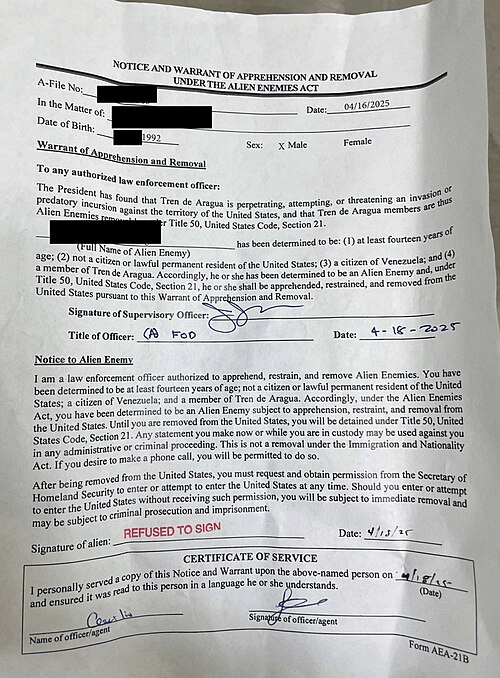
A case in point is President Trump’s use of the Alien Enemies Act.  As a historian, my concern is that this Act is currently being applied with hardly a nod to its tortured history. That’s what happens when historians are demonized: Those in power can ignore us and the story we tell.

This Act passed in 1798 in response to a perceived threat to national security, both at home and abroad. John Adams had followed George Washington into the presidency with the support of the Federalist faction. Meanwhile, an opposition faction, Democratic-Republicans led by Thomas Jefferson, was also being organized.  In general, Federalists believed in strong central government headed by a relatively powerful chief executive; the Democratic-Republicans called for a diffusion of power, not only among the three branches of government but also between state and national authorities. In these early days of political party development, each side viewed the other as an existential threat to the Republic.  Federalists warned that if the Democratic-Republicans prevailed, the nation would degenerate into anarchy and moral decay; the Democratic-Republicans warned that Federalists were conspiring to install a tyrannical government that would restore monarchy. The public had to choose: anarchy or tyranny.

When the British and French went to war, these divisions grew more dangerous, especially since the Federalists favored the British and the Democratic-Republicans sided with the French. Then the French began attacking U.S. ships to disrupt trade with their enemy. Although Adams refused to ask Congress for a formal declaration, a naval war with France ensued. For such a young, inexperienced, and ill-prepared nation to be fighting a war with one of the superpowers of the day was a truly terrifying experience, especially with such extreme internal polarization.   

The Federalists reacted by tying the threat abroad (the French) to the enemy within (the Democratic-Republicans) and passed the infamous Alien and Sedition Acts. The Sedition Act negated the 1st Amendment by making it illegal to criticize officeholders. The Alien Enemies Act upended the 5th Amendment’s promise of due process to all persons (not citizens) so that the president could deport immigrants whom he perceived to be a security risk in wartime.  Since it applied only during a declared war, Adams did not invoke the Alien Enemies Act, but his administration did prosecute opposition newspaper editors and even one member of Congress under its companion piece, the Sedition Act. A panicked public was willing to limit freedom for security. 

Fortunately, by 1800, the people had seen through the Federalists’ use of fear to maintain power and swept Democratic-Republicans into office. The Alien and Sedition Acts seemed to be consigned to the dustbin of history.

However, the Alien Enemies Act remained on the books and has been periodically resurrected to initiate some of the most shameful chapters in our history, most notoriously the internment of Japanese Americans during World War II, an injustice we came to regret. 

At least we were at war then so that the terms of the Act did apply.  Now we have President Trump invoking it when we are not at war against people whose most serious crime is that they don’t align with his politics. And he’s not just sending them to a “relocation camp” but condemning them to the most brutal prison in this hemisphere in collusion with a tyrant known for his violation of human rights. Once again, fear has prepared us to surrender freedom.

If you think President Trump can negate the rights of some but you are safe, you need to ask a historian how power works.  Our only hope is that the American people today will ultimately be as aware and defensive of their rights as our forefathers were in 1800.  Tyranny wins only when the people fail to defend “liberty and justice for all.”

Gilded Flush

Guest Post by P. Ledbetter

Finally, we know what MAGA means when they promise to “Make America Great Again.” It’s now obvious that “again” refers to the Gilded Age, the late 19th century.

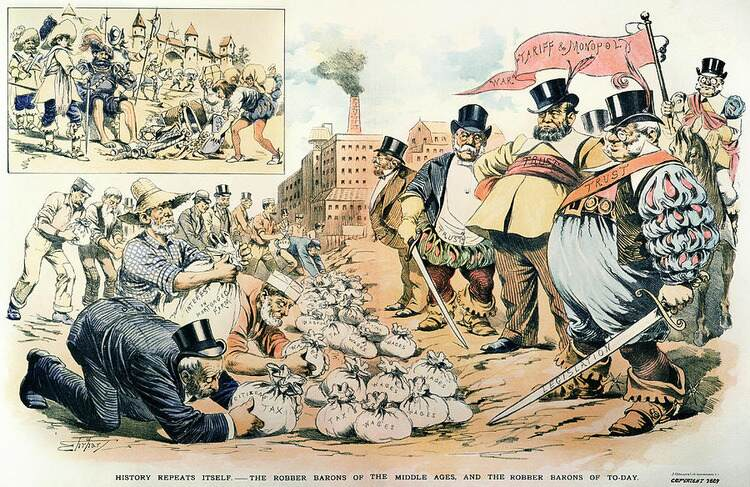
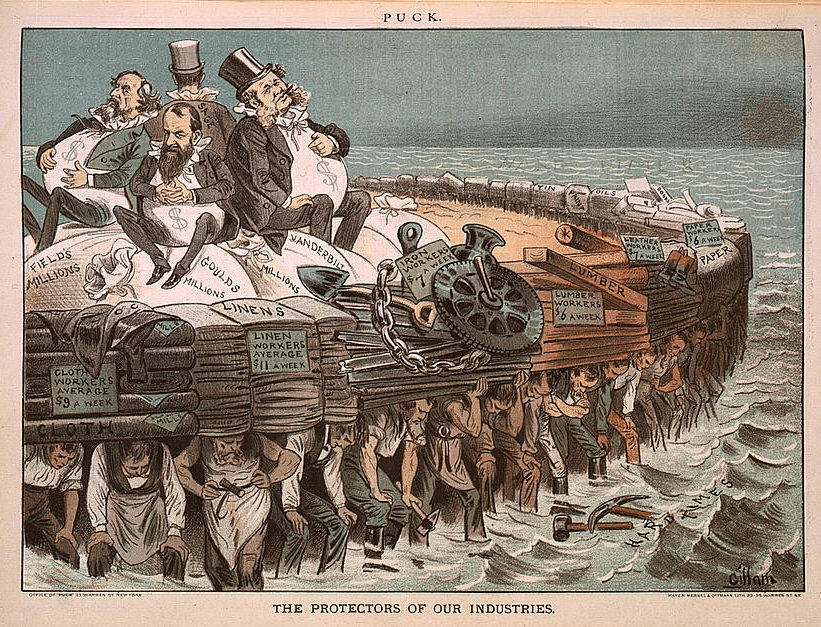
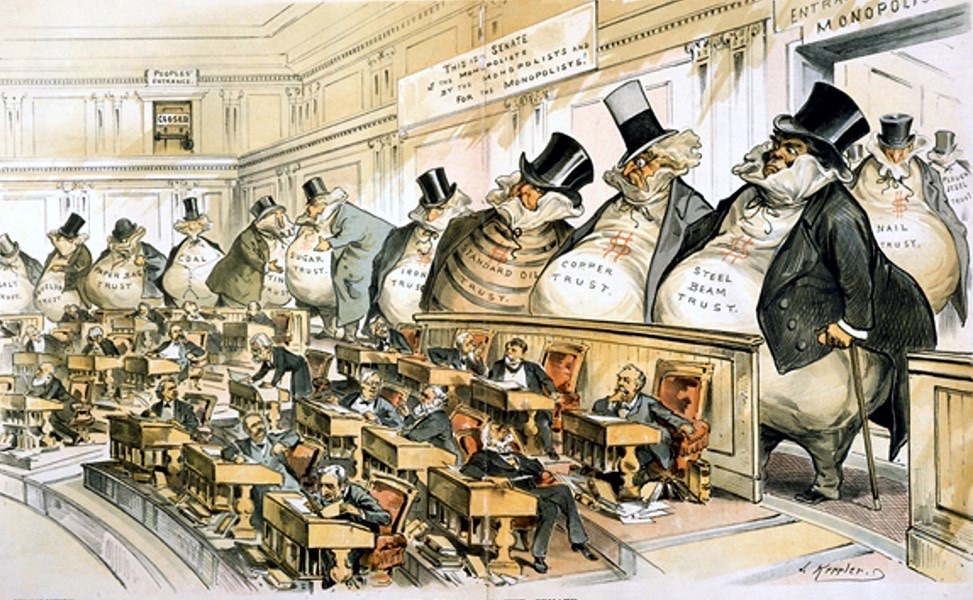
From the 1870s through the 1890s, industrialization launched economic growth beyond any prior generations’ imagination, creating a new class of super-rich magnates (Rockefeller, Morgan, Carnegie, Vanderbilt, Gould). By the turn of the century, their one percent of the population controlled over half of America’s wealth and an even greater share of its political power. America was indeed “great” and very rich, but most Americans were left mired in poverty, under the control of a few men who rigged the system against them.

Under the Trump administration, we see a parallel super-rich class, the tech giants, concentrating wealth and power beyond most of our imaginations (Musk, Bezos, Zuckerberg).  Since President Trump’s election, Musk’s wealth has increased 69%, approximately $70 billion. (Estimates vary but when the numbers get that high, what difference can it make?) Just as with the magnates of old, today’s super billionaires know that with great wealth comes great power: witness Musk’s near total control of our government.

The late 19th century was the most corrupt era of American politics, but it looks like we are on track to match or exceed its record. Today’s billionaires even use the same tactics to gain and keep power. In the first Gilded Age, outright bribes assured control of both state and national governments; today’s bribes are thinly disguised as “campaign contributions” but the results are the same. Gilded Age taxes also mirrored Trump’s plan. Import tariffs assured that only working- and middle-class Americans paid the country’s bills, while the tax advantages went to those who could pay the biggest bribes.  Turns out tariffs are a great way to build a strong political base while shifting money from the poor to the rich.

The 19th century overlords also understood that the best way to control people is to scare them and keep them divided among themselves. In the South, this meant the establishment of the Jim Crow regime that almost universally disenfranchised Black citizens. Meanwhile, vicious attacks on immigrants further frightened and divided those who might otherwise have challenged the super-rich’s power. In today’s climate, if the public’s focus can be kept on DEI and CRT, they won’t notice that they don’t have health care or decent wages. 

The clearest evidence that we are on the road to another Gilded Age is the attack on the administrative state, the so-called “Deep State.”  In the 19th century the super-rich played their game with no rules and no limits. Those were the “good old days” that today’s billionaires long for.  All they need to do is convince the people that their government is their enemy and that rules checking the power of the wealthiest are unwarranted tyranny, and their oligarchy is empowered beyond measure.

The good news is that the first Gilded Age ended with the Populist uprising (real populism, not the fake variety Trump claims.) Interestingly, that resistance to concentrated wealth and power was led in large measure by an unlikely group: Texas farmers. They even saw through the racist regime that kept both races down so that they “may be separately fleeced of their earnings.”  (See Gregg Cantrell’s detailed account, The People’s Revolt: Texas Populists and the Roots of American Liberalism.)

Can we do it again?

On DEI

Satire guest post by P. Ledbetter, Historian and Professor

Our Great Leaders President Trump and Governor Abbott are doing an incredible job stamping out diversity, equity, and inclusion, but I fear they haven’t yet gotten to the root of the problem.  To destroy evil permanently you have to rip it out from its foundations.

We are all aware of the America’s 1776 original sin—the Declaration of Independence. When the radical woke leftist Thomas Jefferson described all men as being created equal and endowed with inalienable rights, he imposed absolute Marxism on our young, unsuspecting republic. How could real Americans have guessed that even slaves and women would soon think that applied to them!

But most Americans are unaware that soon after we gained our independence the same leftist woke agenda got implanted in the Preamble of the Constitution itself: “We the People of the United States, in Order to form a more perfect Union, establish Justice, insure domestic Tranquility, provide for the common defence, promote the general Welfare, and secure the Blessings of Liberty to ourselves and our Posterity, do ordain and establish this Constitution for the United States of America.”

Let’s take a close look at that DEI language.  “We the People” tragically started the woke idea of inclusion, and “a more perfect union” implies that our great Founding Fathers were not already perfect, an idea calculated to destroy future generations’ patriotism. The clause “establish justice” is obviously where the woke idea of equity comes from. “Insure domestic Tranquility” makes some stupid people think that true patriots can’t even storm the capital to overturn elections they don’t like.  “Common defence” implies that the government should defend everyone, even radical leftists! Perhaps the most dangerous phrase is “promote the general Welfare.” We all know how that has been abused to further the dangerous idea that even poor children should be educated, and old people should get pensions and health care. Finally, that last clause extends liberty even to “Posterity”—talk about inclusion! That would include millions of people from all over the world!

With the Declaration and this Preamble, the woke movement almost immediately started the antislavery and women’s rights movements. The radical leftist Marxist Frederick Douglass even claimed the Constitution itself was an antislavery document!  His extremism helped start the Civil War! Then things got even worse after the War when the noble South failed to stamp out diversity, equity, and inclusion. The radical left added the 14thAmendment with its woke language about birthright citizenship, even though everyone knew that the drunken, lazy, violent Irish were already poisoning our blood and polluting our gene pool.  Under that Marxist Amendment, all kinds of people, even the Chinese and Eastern Europeans, got to call themselves Americans and thought that as “persons” they were entitled to equal protection and due process under the law (equity rears its ugly head again!)  

Throughout the 20th century, the woke agenda made it impossible for children to get jobs in the textile mills and coal mines, encouraged workers to form unions, forced businesses to provide safe workplaces, broke up our cherished monopolies ,and demanded DEI even for African Americans—there seemed to be no end to their nonsense! To top it off, they created the Deep State that continues to tyrannize over true Americans, just to stop common sense from overturning their agenda.  

Finally, With President Trump and Governor Abbott we have Great Leaders with good genes and common sense who recognize the evils of diversity, equity, and inclusion. If we can’t get all of the people with bad genes deported, maybe we can adopt Jonathan Swift’s “Modest Proposal” to get rid of them. As he noted, “A young healthy child well nursed, is, at a year old, a most delicious nourishing and wholesome food, whether stewed, roasted, baked, or boiled.”  If we eat the children, as Swift proposed, we can bring down the price of groceries even as we get rid of the immigrant infestation!

Project 2025: No Light Reading

Guest Post by P. Ledbetter

I have finally worked my way through all 922 pages of Project 2025, every word, line, and terrifying paragraph of it. Because of its radicalism and unpopularity, Trump tried to distance himself from it during the campaign; now he is appointing its authors to carry out an agenda he is sure to claim for himself.  I strongly recommend that everyone who is proud of “doing their own research” do what historians in the future will surely have to do: READ IT! 

Its message can be summed up in three words: purge, privatize, and politicize, all with the purpose of establishing a government of billionaires, by billionaires, and for billionaires.  After all, their right-wing think tanks wrote it.

Step one, the purge, depends on demonizing any opposition to the Project’s agenda.  For example, climate scientists are dismissed as part of a dangerous left-wing conspiracy that must be eliminated from all federal agencies.  As these billionaires know, data-driven studies can only limit their concentration of wealth and power.  Likewise, all efforts to support diversity, equity, and inclusion or to give serious consideration to the causes and consequences of racism in American society must be purged. Such efforts threaten the authors’ social control and thus must be portrayed as the “enemy within.”  Those who seek power always know how to mobilize fear of the “other” to divide and destroy opposition.  This Project is truly a masterpiece in that long line of literature.  

Step 2, privatize, is simply the continuation of a long-standing determination to redirect public funds into the pocketbooks of the super-rich. We have seen the failure of this approach with such public functions as prisons and social services.  But this Project’s primary focus is even more dangerous than past efforts: Their vicious attack on public education threatens to destroy an essential foundation of democracy itself.  Not only do they propose abolishing the Department of Education, but they also put forth a nationwide plan for vouchers to undermine publicly-funded schools and empower the billionaires themselves to direct all learning.  They attack higher education as part of the left-wing conspiracy they blame for disrupting their power. Instead, the Project defends private, for-profit colleges that dispense “degrees” without actually educating anyone.  According to the Project, these for-profit systems should be able to create their own accrediting agencies and establish their own standards without oversight.  As they know, perpetuating ignorance makes people more susceptible to fear and thus easier to control.   

Step 3, politicize, involves their plan to essentially repeal the Pendleton Civil Service Act of 1883 and return to the infamous 19th century “spoils system” (“To the victor belong the spoils”, i.e. government jobs). That system was a great way to create a powerful political party, but an inefficient and corrupt way to run a government. Now it seems the billionaires once again prefer a corrupt system where government jobs depend on political loyalty, rather than merit or expertise. The intent of the Project’s proposals is to create a “unitary” executive, a president with near monarchical, unchecked power. All significant government jobs (the so-called “deep state”) are to be appointed based on their loyalty to the president’s agenda. Note that demonizing government workers as the leftist “other” has become yet another way to mobilize fear in order to aggrandize and concentrate power.  

In 1933 when Franklin Roosevelt declared, “All we have to fear is fear itself,” he was offering advice that remains relevant to every democracy in every age.

Because, Not Despite: The Myth-Con and Other Reflections

Reader discretion advised.

It happened because of our disbelief, not despite it.

It’s been some time since I’ve contributed to this blog–a long crippling illness has kept me running low, and I genuinely believed 2024’s election would go differently. If you’re reading this, it’s most likely that you will agree with me in my profound concern about the ghoulish fascism mooring itself on the national soul. Eight years ago, I wrote my first blog post in the wake of Trump’s surprise victory in 2016. The charter of this blog has been to explain, imperfectly, the complex ecosystem of people, power, and history. More concrete, my purpose was varied: to explain to my contemporaries and peers in high tech why such an event could happen and to connect with the activist community eager and willing to invoke needed change. I feel I accomplished the first objective by reaching many. The second led to friendships to activists working for change, like George Polisner and Noam Chomsky. Chomsky read my work, and now that we’re in what essentially is a post-Chomsky world, I would happily put on my own headstone that Noam would reply to my posts within 90 minutes. Today is his 96th birthday, and a fitting day for my post to appear. Whether decent existence still awaits us after this remains to be seen. I’m tired, aging, and vulnerable.

Despite the ubiquitous works of others whose importance and prominence outstrips mine, we have found our way back to a horrifying outcome. My tendency would be to offer compassion to the weary in dark times. A refrain comes to mind after I spent a few days with my college history professor over the week of election: it is because, not despite. What do I mean? The virulent madness spreads because of its suicidal march to extinction, not despite. On the other hand, we refuse to give up, because it is perhaps hopeless, not despite.

My Own History

As I’ve written earlier, I was raised in north central Texas in a moderate-to-conservative family. My birth father (whom I’ve not seen in 28 years) proudly wore his confederate flag-emblazoned shirt around town, and my mother struggled to better herself through education. He was a drunk who abandoned his children; she pushed us to seek a better life through college.

We were evangelicals, though my parents’ divorce in 1987 earned our family certified letters that we could no longer attend our Assembly of God home church. We sought spiritual matters through a few other smaller churches before conceding perhaps our souls were already lost. I say it as a joke since I don’t believe most of it these days.

A quarter century ago, I sat in Pat Ledbetter’s American history class 1302 to study Reconstruction until the 1990s. It’s rare that I can point to any one class which guided my adult awareness of the world, the wokeness, if you will (or won’t since woke is now a racist epithet belonging to the class nigger.)

I learned about American exploits in Cuba, Central America, Africa, the Middle East, Malaysia, and East Timor. I learned that Reagan, Nixon, Eisenhower, McKinley, Kennedy, and Johnson ordered their surrogates to murder, pillage, and plunder in far away places. I wept at these facts; we were raised to believe Reagan had restored the Christian dignity of America, yet I learned of the thousands of people murdered in Grenada, Nicaragua, the Congo, and Indonesia.

How could a nation of the righteous do these things to the rest of the world? The implication was simple in my 19-year-old brain: if America committed atrocities, and the righteous would not, then America was not righteous. This crushed me–I felt helpless rather than empowered, despite the many men and women who struggled to achieve expansion of rights and to civilize a species rife with misery and mayhem. The typical 19-year-old wants the quick and sometimes dirty solution. Well, enough said about that.

I learned later that doing is more important than being; despair undermines the operation by dumping the manure of cynicism all over us. But movement doesn’t happen without motion; it’s a soundbite, but sometimes they comfort.

During the 2000 election cycle, I convinced myself that most everyone studied the same history imparted to me. I was a fool–millions of people voted against their interests for a failed businessman with the presidential name. I believed people would never vote to restore to power the chickenhawks like Cheney, Rumsfeld, and Wolfowitz after their hijinks in decades prior. Of course, if the votes had been counted, Al Gore would have been president. The Brooks Brothers riot astroturfed the malcontents during the recounts–these were not locals with genuine concern around voting tabulation. They were staffers from the RNC. It isn’t that different from the thousands of Trump signs blanketing Tucson and other swing state cities. No, it was because rather than despite.

September 11, 2001 reworked the system. I cried that day, but not just for the Americans lost. I knew our history–I knew we would destroy the lives and families of millions as our lumbering military bungled its way through the Middle East in search of apocryphal bogeymen. And that is exactly what happened: an ineffective, easily manipulated leader eagerly donned his cowboy hat and spurs as he claimed a fan favorite of politicians–a wartime president. Now, mind you, Congress did NOT declare war on Afghanistan and Iraq. But they signaled they would fund whatever Bush 2 wanted. Or rather, what Cheney wanted.

Reshaped Government Roles

The grisly truth is worse. The legislative branch is supposed to be the sole decider in whether we march into war. At least, that’s what the founding fathers intended. But something happened at the close of World War 2–the first and last deployment of nuclear weapons against a wartime foe. Fat Man and Little Boy rearranged military might in a way unforeseen by the founders. Though some debate the necessity of the bombings, I believe Japan was defeated. They floated the idea of surrender, but the Allied Powers refused, just as Bush 2 would refuse to treat with the Taliban when they offered to surrender Bin Laden. You might think America dropped the nukes despite their horrendous consequences, but, once more, think of because. Truman chomped at the bit, even when Hitler balked at wielding power some physicists believed would ignite the atmosphere. The late Daniel Ellsberg wrote a great book about the existential threat no one ever mentions during election season. The point here is that Congress abdicated its war-making power as subsequent presidents of both parties launched aggressive wars against third world nations.

Since that time, it seems that every president receives his opportunity to set the “legislative agenda.” I might be old-fashioned, but it seems that we should rename the branches of the federal government if the president decides what Congress passes. True, he can veto whatever he doesn’t like, but unlimited terms for the legislators means they would rather abdicate their authority than take the fall for the inevitable buyer’s remorse many voters feel each time we do this again. The president can serve two terms (though Trump has insisted otherwise.) He becomes a lame duck in term two, so America can reserve its ire for him when circumstances deteriorate.

There have been several campaigns to consolidate power within the executive, with Project 2025 being the most recent to receive prominence. Unitary executive theory was a predecessor, as were the works of People for the New American Century (PNAC). They range in scope, with all advocating for a fascist transformation of the federal government and society itself. The fact that 77 million people would vote for such an outcome screams disenchantment and fury.

The system is broken, but not because the institutions have failed people–people have failed the institutions. Mitch McConnell was booed by the Trump thugs at the RNC, despite paving the way for SCOTUS to overturn Roe v. Wade and grant sweeping, jaw-droppingly absurd immunity to all POTUSes, current and past. Worse yet, he could have prevented this mess by upholding his oath to protect the Constitution: the Senate should have convicted Trump after January 6. Instead, he bemoaned the lack of accountability, despite shaping SCOTUS and refusing to press his colleagues to ban Trump from office thenceforth. Why did they jeer him? Because he spoke against Trump, despite playing power games sufficient to coronate Trump for all time. But that’s just it–kissing the ring once isn’t enough. And his inner circle has sheltered numerous allies now in jail for the rampant corruption they shared with him.

Trump Was and Continues To Be No Biden

In 2016, cock-eyed optimists with wispy straggle beards could argue that Trump might make changes to improve the outlook for the labor class. I heard arguments about his outsider-ness, his stubbornness, and his success in business. I knew none of those would serve American interests since he was a Thanksgiving table of government handouts in his business dealings, that he couldn’t back away from even the most indefensible position, and that he somehow could straighten the whole of the federal government by knowing nothing about it. His people started a flag-craze, erecting thousands of TRUMP and MAGA flags. I don’t remember anyone putting a president’s name on a flag to fly alongside Stars and Stripes. Despite my doubts, I started the blog to share my perspective on the forlorn, forgotten working class. I could understand that part of their intentions, even if the xenophobia and misogyny took the lead. I attempted civility, steering away from the baser insults all of us might feel.

For those four years, I blogged regularly on Trump’s escapades and the stories of many who stood strong against him. I don’t want to rewrite what I wrote, so feel free to look at past posts yourself.

Decision 2024 is different. We’ve endured a Trump term, and the policy choices during COVID alone rise to the level of boneheaded, chaotic blunders, if not “high crimes and misdemeanors.” Over one million Americans died, and many others, myself included, suffer with long-term consequences of the first run. Even if grandma and grandpa are expendable (and I heard plenty say so), the job losses were catastrophic in 2020. Those of us who paid attention to those ugly four years cannot deny how much worse our world was. Everyday was filled with insanity–he was vicious, cruel, incompetent, and a disaster. Kamala’s words will come back to haunt us.

Biden assumed as president in January of 2021, and he made enormous headway in both undoing the damage of Trump’s term and advocating hard for student borrowers, victims of gun violence, infrastructure improvements, and much more. Politico‘s article explains it well. His accomplishments include strengthening the CDC and hardening our response to future pandemics, passing infrastructure bills, working to reduce financial burdens on student borrowers, and presiding over an economic recovery. What did he do wrong?

For four years, Trump’s surrogates (such as hyenas like Elon Musk and Vivek Ramaswamy) and MAGA clowns in Congress have schemed and plotted, obstructing Biden and congressional Democrats. These rightwing ideologues spent countless dollars demonizing transgendered Americans and immigrants, persuading people even in Tucson 60 miles north of the border that we are awash in immigrant crime. Newsflash for anyone who cares–there is no migrant crime problem that’s any worse than it was when Trump was president. It’s stunning, but I assume social media remains a lifeline for people looking for things to hate and fear. The RNC spent $250M on attacking the trans community, and Democratic pundits and politicians claim this led to Kamala’s defeat, despite her saying almost nothing on it. The heartless ads produced show pictures of huge men in wigs towering over women basketball players and ballerinas. Why support such cruelty? It was because, not despite.

Their attack ads originally focused on Biden’s age, despite Trump’s very clear cognitive decline. Or rather, because: Trump is easily manipulated with flattery, providing an opening to the greedy among his inner circle. One of his attorneys is already cashing in, selling administration posts to the highest bidder. Trump’s Caligula cabinet picks are so ridiculous, I won’t delve into the details here. It suffices to saw that national security and smooth access to government agencies will be longer term casualties in Musk’s war on America. Even the mainstream media paid excessive attention to Biden’s gaffes while ignoring Trump’s lunacy. After the attempted assassination of Trump, his supporters claimed that Democratic rhetoric was to blame. Nevermind Trump’s own violent diction, fantasizing in public about shooting Liz Cheney, executing immigrants, and jailing all his opponents. Nevermind that it was a Republican who tried to kill him. Nevermind… Ah, whatever.

The point I would make here is that Trump is NOT an unknown quantity this time. We know what his years were like, and several million people stayed home on election day rather than help choose the first woman president. She, like Biden before her, would play with everyone, not just her friends. She didn’t lose because she ran her campaign badly–she articulated her plan well, she was civil, and she was the sole major candidate to treat with the Republican’s central issue: immigration. She was a prosecutor–law and order conservatives should have cheered this. Instead, they chose a convicted felon who stole and imperiled national secrets, who attempted to overthrow the government with violence, and who attempted to change the outcome of an election he didn’t like.

Trump supporters had ample evidence of the harm he could unleash. They chose him in any case, and it means America failed that class and we have to take it once more. I never believed Trump would shock and awe his critics into joining his cause. Does that mean I am among the “enemy within” Trump promises to eliminate with the military?

New (or maybe old?) tactics include:

I could list more, but I think it’s better to leave my past posts as a testament to his many failings; they are numerous like the stars in the heavens and fleas on a dog. It’s important to take a step back to consider his campaign “promises.” Tariffs and ending illegals’ stay in America will wreck the financial market and cripple the consumer base. The point I would make here is that his plans aren’t really plans at all, and his supporters who scream about it don’t understand the first thing about them.

Localizing the Effort

Rather than learning about how things work, Americans stew and seethe in crippling anger. Pew and other polling organizations have reported this for some years now. What is new to me is the degree of hoodlumry even in the very nice neighborhood I call home in Tucson. Signs blanket-astroturfed Tucson drawing inane comparisons: Trump=Low Prices, Kamala=High Prices, and the like. I thought voters were smarter. My physical limitations notwithstanding, I placed $200 worth of Harris/Walz signs on the two thoroughfares near my home, and they were stolen and defaced within 24 hours of their placement. Keep in mind this is a 60 Blue/40 Red spot in Tucson, yet a thousand or more Trump signs went up. Some of those were stolen, but ALL of my signs were destroyed. These aren’t brown hoards rushing us from the border–they’re middle-aged and older white men (like myself) who think nothing of tearing up another’s property and right to speech. Kelly and I replaced the signs on two occasions, and we were met with harassment and derision by some of the passers-by. Though I voted by mail, an elderly friend of mine needed to vote in-person, so I drove him there. In the fifteen minutes I sat in the waiting area, conspicuously MAGA folk appeared to harass the poll worker and pull others around them into the grand show of it they were putting on. Again, these are white men. Grown narcissistic men with nothing better to do.

In the five years since moving to Tucson, I’ve experienced only a few instances of crime committed against me. It was almost always a white man (once an old white woman), NEVER a brown illegal or trans person or bloodsucking schoolteacher with designs on your kids or whatever else gives these people nightmares. This is anecdotal, but it’s very much worth pointing out.

Tilting at Them Thar Windmills

I visited my hometown Gainesville in Texas around the election to be with a dear friend in the hospital. In the years since I moved away, a few windmills have sprouted northeast of town. And what attempt at green energy would be without the hysterical signage of fools afraid of it? But I was immediately struck at the utter lack of political signs anywhere in town. Of course, it’s a safely red district, so the Musk/Ramaswamy/Koch money machine didn’t direct their deepfake signs there. But there were a few choice markers, like one deriding Tim Walz as a klutz. My brother Robin often bemoans that there are few things “to put one’s back up against” anymore–it used to be that Republicans would delight in a candidate retired from the military over a draft-dodger like Trump, but it is no more. They swing at everything, including the constituencies they once praised. In my hometown, they posted a billboard of Walz with the word “KNUCKLEHEAD” painted beneath him. To be clear, Walz has much more in common with my old Gainesville than Trump or even Vance. But is this a surprise? Trump ridiculed John McCain, a man who once meant something to Republicans. It’s now just power lust, feral, aimed at everything, and bent on domination.

The numbers are interesting: Harris received roughly 74.5M votes to Trump’s 77.0M. In 2020, Biden received 81.3M to Trump’s 74.2M. When adjusted for the growth of the electorate, neither party scored as well as they did in 2020. Trump came closer with an increase of 3.7% voter share, but this still lagged the 5% true growth from 2020 to 2024. What does it mean? The 2024 election simply attracted many million fewer voters than did the event four years ago. A narrative frequently pushed by progressives is that if everyone voted, we would win. At the least, this year’s election affirms this. 66.6% of the electorate voted in 2020, versus 63.7% in 2024. The raw difference in the electorate was 12 million, but the difference in voting blocks was 4 million, down from the 8 million required to meet 2020’s same percentage. True, these are the sorts of facts we progressives claw and pick over to find that one thing we can safely place our backs against. If anything, it underscores the lack of a mandate for the Republicans (and they have failed to earn a majority of votes cast since 2004.) But the ‘winner-takes-all’ feature of our system assigns power to the winning side with little power resting with the losing party. In other words, Trump, as has been true in all elections with him at the top of the ticket, will rule as if he received a majority of the popular vote. Both Biden and Obama, by contrast, won with majority popular votes.

It’s worth taking a moment to look at deltas one cannot obtain without painstaking data entry. First, I computed the number of votes lost from 2020 to 2024 for each state and party. Second, I determined the number of votes needed to flip a state from red to blue. Finally, I calculated the share of lost votes needed to accomplish that change. The states where this was even possible appear below–the hill was a little steep but quite possible. The conventional wisdom that Democrats win if more people vote does seem to be correct.

It doesn’t affect the pragmatics one wit–Trump will govern as if a supermajority of Americans wanted him. He barely did better than his previous outings, succeeding because millions didn’t vote. The challenge for minority rule is treating with the disenfranchised. More people voted for Hillary in 2016 than Trump, but our voices were more than just stifled: he delayed aid to California during wildfires (and he promises to do worse the second time around.) The real problem is that Trump is crazy, and if others tell him that he won, like the perpetual victim Kari Lake, he finds himself needing to believe it. It’s part of the myth-con.

But with the good medicine comes the bad: Trump’s hold on sanity is gone, along with any hope that the two coequal branches can place him in check. The billionaires backing him are in agreement with Harris: Trump is weak and easily manipulated. He’s already picked a grab-bag of cabinet toadies claiming they’ll do his bidding, though the real litmus test requires them to shower him with praise. His choices are inept and reckless: they don’t know the first thing about leading an organization of any kind, let alone a federal agency. The ensuing chaos will suit Trump to a tee.

Speaking of billionaires, it’s worth mentioning that Elon Musk’s embrace of all things Trump following the assassination attempt last summer didn’t mark the off-the-deep-end moment for the world’s richest person. In the past few years, he’s made increasingly crazy statements, fueling his promotions with his wealth and a folk-hero status to the technocrats. He is a splendid example of the danger of believing one’s own press: he’s the richest person, so he must know what he’s saying. No, he is insane because of his wealth, not despite it.

Narcissist Musk tilts at them thar windmills: destroying Twitter in the name of free speech, enforcing illegal and hazardous constraints on Tesla workers to make the otherwise unprofitable business viable, and fighting literally dozens of suits brought by states and the federal government for workplace violations while executing and bankrolling dozens more suits against his enemies. His true skill is playing the Machiavellian, arguing for his own First Amendment while blasting others for speaking up. He and DEI-foe Ramaswamy plan to destroy the civil service, replacing it with workaholics who faint after 12-hour shifts. Good luck finding that.

Musk’s insanity makes him a true enemy within, an immigrant playing cuckoo bird as an innovator and savior to humanity. He has, like Rupert Murdoch before him, invaded our country on a quest to hollow us out from the inside. Vance is another cuckoo, claiming an Appalachian homespun origin while attending ivy league schools. Like George Santos, he has learned the Roy Cohn art of saying whatever is necessary to win.

This is a pattern: Trump’s inner orbit attracts the same sort of myth-conning that has propelled him to the presidency now twice. RFK, Jr. fits the bill–he’s unscientific, narcissistic, and just plain nuts. He believes vaccines cause autism, that wireless tech causes cancer, and that COVID is a conspiracy against whites and blacks designed by the Chinese. Jesus, I don’t know what else to say. He will lead the FDA.

What more? A wrestling exec will lead the Department of Education, a news host the Defense Department, an NFL alum the Department of Urban Planning, another news host the Department of Transportation. Ugh, never mind. Bob Woodward squinted as hard as he could to find the micron of optimism, but he’s since changed his mind.

Woke and DEI to Blame?

And we mustn’t stop there: Harris’s defeat led pundits to proclaim the death of wokeness, blackness, diversity, and inclusiveness. Maybe Harris’s blackness and woman-ness kept people home, but I don’t think so. It takes genius not to see it, to quote Chomsky. One would never say that a cancer survivor losing an election means that we can’t treat cancer anymore–such a fool would be laughed right off the soundstage.

Blaming wokeness for Kamala’s loss is no less idiotic than blaming oncology because a cancer survivor loses an election.

It comes down to the narrative that Trump’s supporters pushed from the beginning–he’s better with the economy. People are tired of paying more for less, despite the requisite cycle to recovery from recessions. Allan Lichtman and his keys predicted Harris to win based on indicators that should have been in her favor. I believe the true culprit is in the “doppelganger” world I described a few years ago. Naomi Klein wrote a book of the same name last year. Information is asymmetric, preselected by unaccountable algorithms running in social media platforms. People genuinely believe that the immigrant crimewave is real. They believe trans people are perverted men wanting to push their way into women’s sports and bathrooms. They believe DEI initiatives undermine the fabric of business and family. They believe immigrants are roasting America’s dogs and cats. How does this happen? Why do people believe these things without actually seeing them happen?

I think it comes down to a very human need to manage anger and despair. People know eggs cost twice as much as they did four years ago. They’re angry that the rich continue to get richer while everyone else pays more for less. Trump’s backers know this all-too-well, and refocusing extant anger is propaganda 101.

DEI is an enemy for Ramaswamy and Musk: in the latter’s view, it is discriminatory. Of course, these are not data-informed positions–they’ve fallen for a gimmick as old as civilization itself: conflating rare, good fortune with wisdom. Money is the thing that matters to Trump in any case.

Musk has given us plenty of samples of his inner workings, threatening federal workers and anyone he perceives as the enemy. It turns out that he’s also quite stupid, targeting employees who work on ecological diversification rather than diversity and inclusion. No matter the brain rot gnawing at him, his tactics mobilize Trump’s brownshirts to drive these people from their homes. The DOGE (department of government efficiency) promises to purge the civil service of practically all expertise, with half-wit loyalists prepared to take up residence. It is a grim portent of what Trump’s second term promises: cruelty and vengeance.

How Goes the Myth-Con?

Rallying otherwise decent people to do evil isn’t new. As we’ve observed before, totalitarianism begins not with a twirling mustachio and his manifesto to do harm, but rather a white knight claiming to want to save those decent people. The most tyrannical regimes in the world invoke their authority from democracy, divinity, and freedom. They don’t appear in the shadows, twirling their mustaches. Except when they do: Trump isn’t popular, nor has he ever been. But he is a hero to his ardent supporters. While visiting Phoenix, I came across a lot with twenty or so American flags, together with a poster of Trump which canonizes him by the two impeachments and one assassination attempt. (This replaced a “Let’s Go Brandon” flag this brain trust flew over his house.) In other words, the bad guys wanted Trump gone, so that means he’s a good guy. I call this the myth-con. He is deified precisely because of consequences deriving from the response he’s coerced from others.

Like Hitler before him, Trump’s attempted assassination was carried out by a rightwing gunman who snapped. His surrogates were quick to blame the Democrats and their rhetoric for the attack, despite his very, very long history of ratcheting up violent threats. He even went so far as to threaten Liz Cheney’s life by firing squad. She voted with his bloc over 95% of the time, but resisting the rise of fascism is just a bridge to far.

To be clear, the conservative chicken hawks of yesterday are to blame for Trump, even if they decided he was bad news later on. Karl Rove, Donald Rumsfeld, Paul Wolfowitz, Dick Cheney, George HW Bush, and many others sought to radicalize the federal government through their Congressional allies and, of course, the figure-heads George W. Bush and Ronald Reagan. Former Republican strategist Stuart Stevens says this was always the core of his party’s intent. I remember the Bush administration destroying careers of CIA Agent Valerie Plame and her husband Joseph Wilson because the latter opposed the war in Iraq in his capacity as US diplomat. The release of her identity imperiled her contacts, but we already know that the fascist calculus demands total obedience. Though Scooter Libby took the fall, it’s possible the conspiracy rose all the way to the vice president’s office.

I don’t remember believing it was as consequential as the millions displaced and murdered by Bush’s illegal wars in Afghanistan and Iraq, but it demonstrates a hatred even for the sacred cows who oppose the feral party. Trump (the draft-dodging crook) belittled John McCain (the veteran and tortured POW), despite the military sitting atop the conservative pantheon of what is good and right. McCain died, and his Arizona voted Trump back to power in 2024. The myth-con requires key ingredients: the gladiator struggles against a corrupt system with nothing less than divine calling to save the marginalized and disaffected from aggressive hoards. Hitler had his Jews, Trump has his Mexicans.

Let’s take these ingredients: Trump is a gladiator. He swings at everything because, not despite his moral and personal failings. The system is corrupt: Americans know that the economic order is unfair. Many work hard, few receive rewards. For years, they’ve paid more for eggs and gasoline–though these aren’t the only metrics of value, they’re enough to enrage ordinary people. The white working and uneducated classes are deeply disaffected–DEI and wokeness appears to benefit brown women, and that bothers them. Jordan Peterson and Joe Rogan tell young white men that they’re victims, too. Because they’re already unhappy, it’s easy to blame the deepfake hoards pouring across the border. Immigrant crime is almost nonexistent, but social media locks people online by triggering the most powerful emotions. They decide that the Haitians eat American pets because they’re angry about longer working hours with less pay, and the regressive sales tax that is inflation. The “otherness” easily depicts the Democratic choice–she’s a black woman. Never mind that she ran one of the most conservative Democratic campaigns of the past fifty years. The myth-con can succeed on the strength of well-intentioned pollsters and pundits who play to the state narrative, as you can see in Bill Maher’s recent interview with Jane Fonda. Rather than admit that Trumpism is avarice and bigotry, his surrogates would insist that Kamala is for “they/them”. Biden was more openly pro-LGBTQ, but he’s an old white dude with a good Christian name.

The myth-con can succeed on the strength of well-intentioned pollsters and pundits who play to the base narrative.

The last ingredient is actually the hardest for me to understand: the divine calling. Trump himself claimed that God saved him from assassination so he could save the country. I would argue that people believe lionize Trump despite his cruelty and utter absence of morality. But I believe, like my history professor before me, that it is because of these things. Fanatical apologists believe he will repair their faith in decline. Others call him King David, Jehu, or Moses: his failings are the reason for his deification. Trump’s appointments to SCOTUS overturned Roe v. Wade, a long-sought event celebrated in most quarters of conservative Christendom. It doesn’t matter what Trump says or does. Abusing women, paying porn stars, and elevating to powerful positions the most corrupt among us augments rather than diminishes him in their judgment.

It’s unfocused, raw anger. And they’re easily manipulated, like Trump himself. All the ingredients are there, despite much of the mess following Trump’s botched COVID response. But there’s no taste for thinking things through, as disappointing as it is. Even mainstream media fails spectacularly in hitting the salient points hard enough. They announce dispassionately that Trump will seek revenge against his many real and imagined enemies, as though this is normal. Ignorance seems necessary for a demagogue to ascend. Ladies, gentlemen, and everyone else: we’ve been myth-conned.

The how of the myth-con is pretty clear. But why do this? Is being the richest man in the world insufficient for Elon Musk? Can Trump not just enjoy his last years with adoring mobs and merchandise? No, and no: no amount of money will ever satisfy Musk, and nothing short of the throne is good enough for Trump. It is because, not despite. Trump learned long ago from Roy Cohn that leaning into the accusations is the way to beat them. Bob Woodward said in 2020 that he didn’t believe Trump knew the difference between fact and fiction. I would tend to agree–Trump just emits shit, and his lapdogs scarf it down. They twist and twirl to keep it pieced together, but the whole of it will fall.

But Why? For God’s Sake, Why?

When my grandmother and her older sister were growing up in Oklahoma in the 1920s and 1930s, they fought from time to time, as children often do. But there was a sharp difference between their respective tenors: when her sister was angry, she broke my grandmother’s toys; when she was angry, she refrained from it. Her rationale was, “I knew we wouldn’t be mad later.” That is, for anyone who cares to know, perhaps the biggest difference between the two political parties in America. The Democrats play to the mainstream to get work done, while the Republicans obstruct and destroy when not in power, then grasp and claw once they persuade the electorate that the Democrats are responsible. Don’t believe me? Mitch McConnell wasn’t the first obstructionist; one can go back to the 1990s for the shitshow that was Gingrich’s Contract with America. Clinton was as close to a classical Republican as we’ve had in that office since the Reagan years, and they still spent years investigating and slandering him. Many of those same hyenas are still in Congress, and they think Trump’s actions are just fine.

Soon, we won’t need the Republicans to break all our toys–catastrophic climate change and nuclear proliferation remain the two greatest threats to our biosphere with no coherent mainstream message.

But it isn’t satisfying enough to say that they’re rotten apples–we progressives often strain to find the silver lining, that one explanation or motivation that can save their souls. But I’ll say it here–my grandmother’s sister was just plain bad. Sure, she was mentally ill (probably schizophrenia), but she was monstrously abusive to her daughter. Long after her sister’s death, my grandmother felt for her. She was charitable in that regard, even when it was repaid with viciousness.

Soon, we won’t need the Republicans to break all our toys–catastrophic climate change and nuclear proliferation remain the two greatest threats to our biosphere with no coherent mainstream message. The former dwells only in the minds of thinking people, utterly disregarded by Trump and his flunkies. But I believe the Rupert Murdochs and the Elon Musks have surrendered hope that this world can be saved. But I’ll repeat it: if the world cannot be saved, it is because rather than despite their unbelief. The money Musk dumped into Trump’s war chest could have been spent solving rather than creating problems. The billion dollars spent on the election itself could have fixed a plethora of issues throughout the world. Instead, that money finds its ways into deeper pockets.

Taking Our Lumps

As I said earlier, I’ve tried to explain the outcomes precisely because I am a progressive–I want to believe that there is redemption for the wicked. But the 77 million people who chose Trump, along with the 50 million who refused to vote, know now what they’re getting. For another term, we will contend with lawless chaos with an even sharper edge. The evangelicals who selected a sex offender can kneel at all the crosses they want. The attack dog brownshirts answering Trump’s call to chase good people out of their own homes can gush at the flag and praise law and order as they step on Capitol policemen’s faces. SCOTUS has assured Trump everlasting immunity, and therefore he has nothing to fear. I wish I could say the same for us.

Is there a next move? Biden is thinking of pardoning Trump’s intended victims–that isn’t the reason the president has this power, but it exists to permit him the opportunity to cure legal failures. The usual folk will oppose Trump’s batshit crazy agenda. Musk will help him weaponize the soon-to-be-gutted bureaucracy to isolate and eradicate enemies. The House once more voted to supply the president with unilateral power in classifying nonprofits as terrorist. With AI tools, they plan to eliminate the “enemy from within,” or the ordinary folk French revolutionaries claimed to represent, even as they killed them during the Reign of Terror. Obviously, opposing the use of unaccountable technology will become a staple. The one silver lining I can find in all this is that Trump’s lone contribution to any enterprise is the sowing of discord and chaos. It might be difficult for him to execute an agenda while riding the highs and lows of dementia and insanity. But I’m running low on hope. I’m aging, ailing, and grieving.

Are there steps forward? Yes!

  1. Read about American history. Zinn’s A People’s History of the United States features many ways forward, none of which are secret. Labor unions, solidarity, and mutual support make it possible to build strength.
  2. Listen to sensible sources of information. Timothy Snyder, Robert Reich, and Amy Goodman supply that, along with inspiration and wisdom. The day is dark, and though cruelty seems to have won a major victory, people can surprise us. But it isn’t enough to just sit and wait for the world we want–it requires dedication and very hard work.
  3. Kick nihilism to the curb. I was once told by a brother that kindness to a person with terminal cancer was a waste, because, “He was gonna fucking die anyway.” I disagree–that’s when we have the opportunity to show the universe who and what we are. Candles burn brightest in the darkest spaces.
  4. Education is a categorical imperative. Learn all you can. The generative networks used to cheat on homework and manipulate users will drain brains everywhere. You’ll be rare as hens’ teeth if you know anything about anything.
  5. Support independent media. Join sites like civ.works and Democracy Now.
  6. Boycott the bad actors.
  7. Talk to each other. People will surprise you if you give them a chance.
  8. Protect each other. Stand in solidarity with trans, immigrants, women, blacks, gay people, elderly people, and, well, people.
  9. Strengthen education. Generative AI has hurtled us closer to educational bankruptcy. It is unaccountable and dangerous, designed principally to retain platform users until they convert (buy something.)
  10. Do NOT fall for the myth-con, no matter who promotes it. Take sociopaths at their word.
  11. Love each other.

This will be my final post for a season. I’ve spent considerable time researching and writing, and though the work is far from finished, I’m exhausted. I will still be here, so don’t feel as though you can’t reach out. I hope for better health, a return to my career, and a better world. Because, not despite.